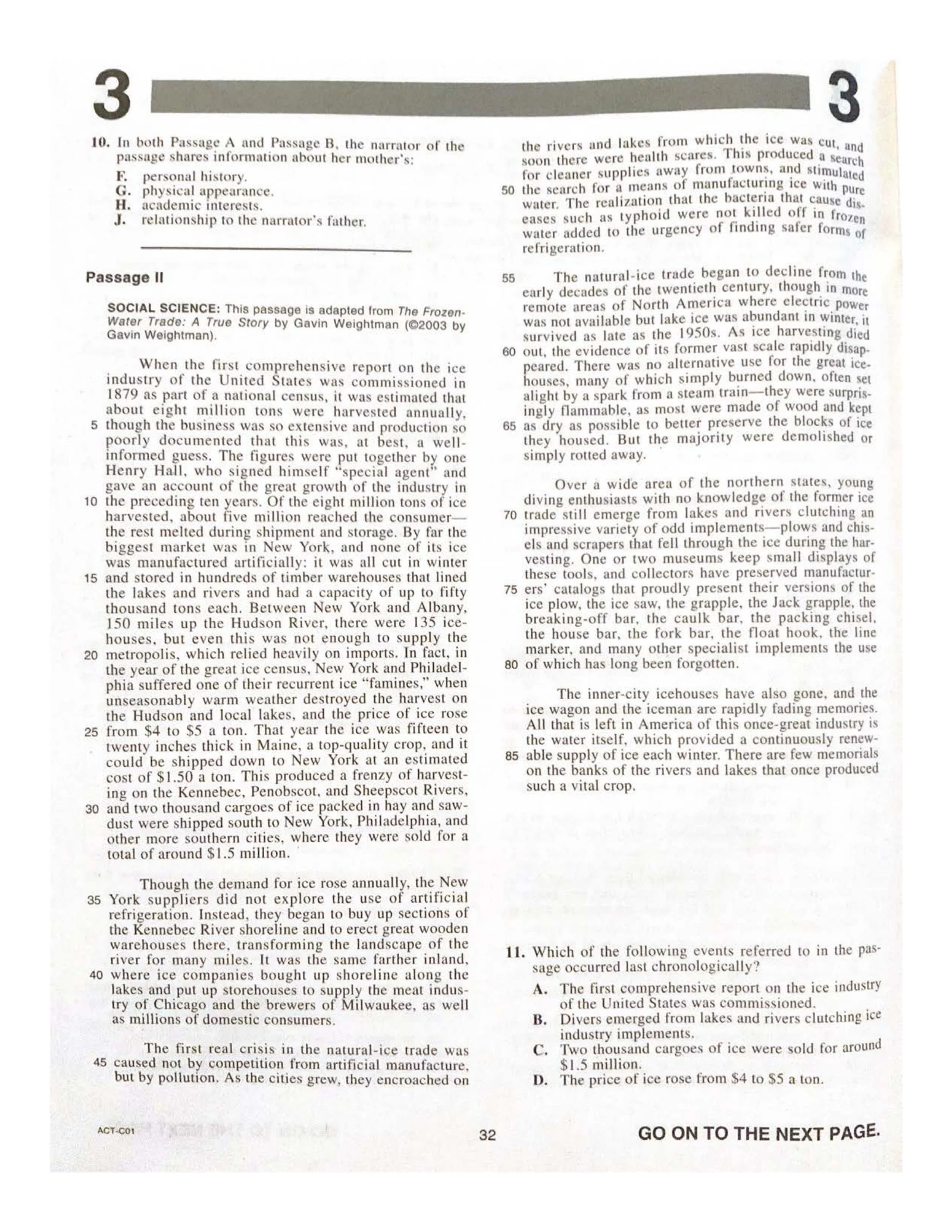
In both Passage A and Passage B, the narrator of the passage shares information about her mother's: relationship to the narrator's father. Passage I SOCIAL SCIENCE: This passage is adapted from The Frozen- Water Trade: A True Story by Gavin Weightman (©2003 by Gavin Weightman). When the first comprehensive report on the ice industry of the United States was commissioned in 1879 as part of a national census, it was estimated that about eight million tons were harvested annually, 5 though the business was so extensive and production so poorly documented that this was, at best, a well- informed guess. The figures were put together by one Henry Hall, who signed himself "special agent" gave an account of the great growth of the industry in 10 the preceding ten years. Of the eight million tons of ice harvested, about five million reached the consumer- the rest melted during shipment and storage. By far the biggest market was in New York, and none of its ice was manufactured artificially: it was all cut in winter 15 and stored in hundreds of timber warehouses that lined the lakes and rivers and had a capacity of up to fifty thousand tons each. Between New York and Albany. 150 miles up the Hudson River, there were 135 ice- houses, but even this was not enough to supply the 20 metropolis, which relied heavily on imports. In fact, in the year of the great ice census, New York and Philadel- phia suffered one of their recurrent ice "famines," when unseasonably warm weather destroyed the harvest on the Hudson and local lakes, and the price of ice rose 25 from $4 to $5 a ton. That year the ice was fifteen to twenty inches thick in Maine, a top-quality crop, and it could be shipped down to New York at an estimated cost of $1.50 a ton. This produced a frenzy of harvest- ing on the Kennebec, Penobscot, and Sheepscot Rivers, 30 and two thousand cargoes of ice packed in hay and saw- dust were shipped south to New York, Philadelphia, and other more southern cities, where they were sold for a total of around $1.5 million. Though the demand for ice rose annually, the New 35 York suppliers did not explore the use of refrigeration. Instead, they began to buy up sections of the Kennebec River shoreline and to erect great wooden warehouses there, transforming the landscape of the river for many miles. It was the same farther inland, where ice companies bought up shoreline along the lakes and put up storehouses to supply the meat indus- try of Chicago and the brewers of Milwaukee, as well as millions of domestic consumers. The first real crisis in the natural-ice trade was 45 caused not by competition from artificial manufacture, but by pollution. As the cities grew, they encroached on 3 the rivers and lakes from which the ice was cut, and soon there were health scares. This produced a Search for cleaner supplies away from towns, and stimulated so the search for a means of manufacturing ice with pure water. The realization that the bacteria that cause dis- eases such as typhoid were not killed off in frozen water added to the urgency of finding safer forms of refrigeration. The natural-ice trade began to decline from the early decades of the twentieth century, though in more remote areas of North America where electric power was not available but lake ice was abundant in winter, it survived as late as the 1950s. As ice harvesting died 60 out, the evidence of its former vast scale rapidly disap- ›eared. There was no alternative use for the great ice- mouses, many of which simply burned down, often ser alight by a spark from a steam train—they were surpris- ingly flammable, as most were made of wood and kept 65 as dry as possible to better preserve the blocks of ice they housed. But the majority were demolished or simply rotted away. Over a wide area of the northern states, young diving enthusiasts with no knowledge of the former ice 70 trade still emerge from lakes and rivers clutching an impressive variety of odd implements—plows and chis- els and scrapers that fell through the ice during the har- vesting. One or two museums keep small displays of these tools, and collectors have preserved manufactur- 75 ers catalogs that proudly present their versions of the ice plow, the ice saw, the grapple, the Jack grapple, the breaking-off bar, the caulk bar, the packing chisel, the house bar, the fork bar, the float hook, the line marker, and many other specialist implements the use 80 of which has long been forgotten. The inner-city icehouses have also gone, and the ice wagon and the iceman are rapidly fading memories. All that is left in America of this once-great industry is the water itsell, which provided a continuously renew- able supply of ice each winter. There are few memorials on the banks of the rivers and lakes that once produced such a vital crop. ACT-CO1 32