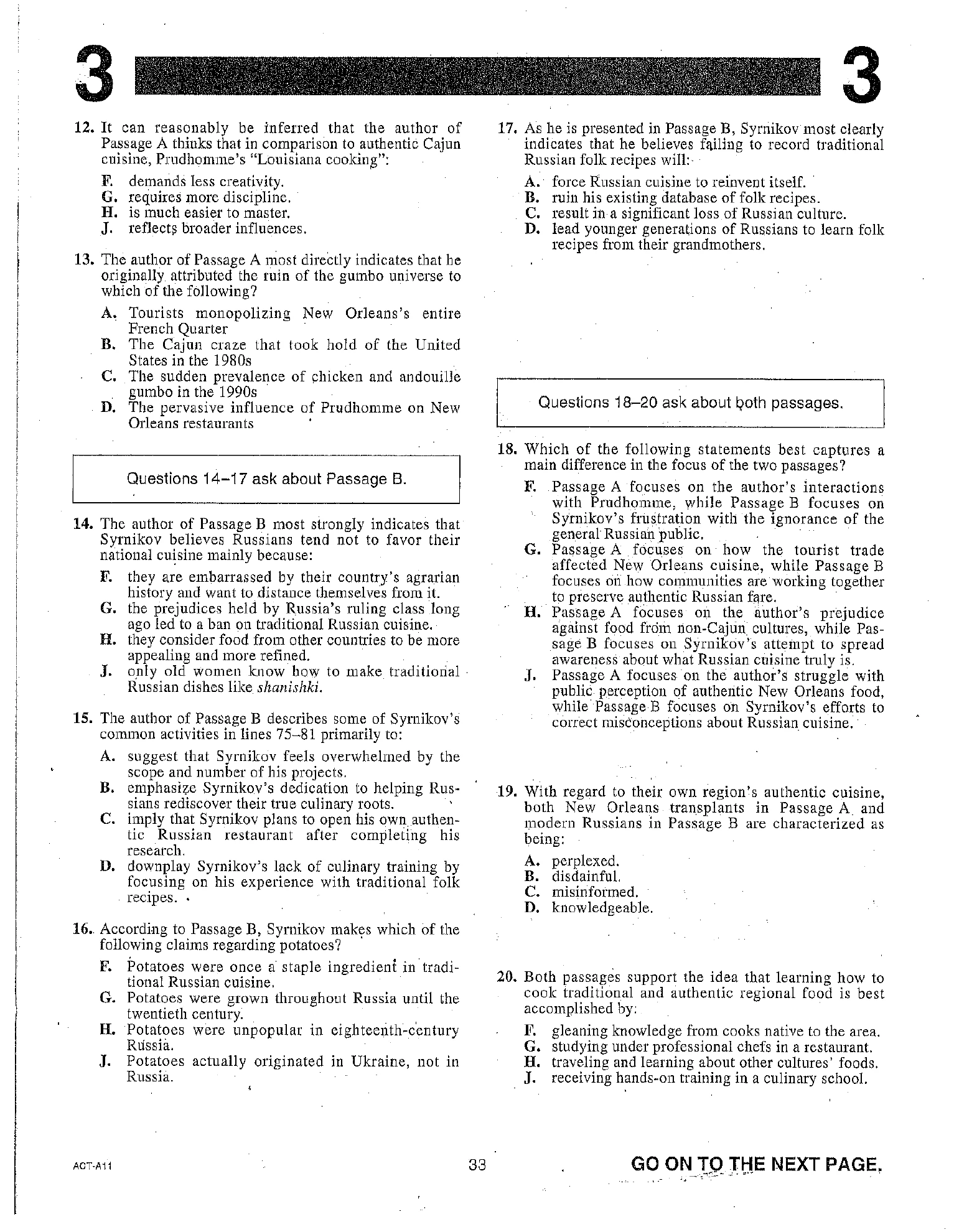
Both passages support ihe idea that leai'ning how to cook tradiiiotLal and authenlic i-egioiiaL food is best accomplished by.. gleaning knowledge froni cooks native to the area. studying undei professional ehefs in a Icstauianl. receiving hands-on ti aiiiing in a culinwc scliool. ACT-A11 33 GO ON TQ THE NEXT PAGE. Passage111 HUMANITIES: This passage Is adarted -.rom Ik.e article "An Interview with C. E. Morgan" by Thomas Fabisiak ffQ,2010 by University ol North Carolina-chapel H11). All thp Living is C. E. Morgan's dobu-. novel. Set in iural Ken- tucky In Ihe 198Ds, her novel lollovi8 a young couple'8 Qtrug- gl88 as they lake responsibiliiy for a lamily faim. ThoJllas Fabisiak: Iii what was. does the fac that your desci"iptive work iii All the Living foknuses on land-- mir ke it a politiciil 1¢ Ct? C, E. Morgan. I think it's akiii to thc moral force Lqat. 5 there in fiction in tlie presentation of ~haracter. Ficiion asks us to bling sustained atie1tiDn to the Other: Ivhen a readei choo8es to continue reading a Doiiel. reoardles of the likability of cq char<lCter, the sustaine(i attention to Lhal chciractei" has moral ramifications. Landscape wrii- 10 ing-most especially when it's done at length and in a style that deviaLes fiom prose norms, so thal its ver). presentation is interrLlPtive or 'estranging" as the for- mcilists might have said-eiicoLITagcs the rder to stop, reread, listen, imagine, ieconbiaer: adTriire: apprec121e 15 with ncw eyes. The reader Inight complain ihat this kind of wi'lting drclws attention to itself. bu- th;.s kind of wriling doesn't mei'ely draw attention to its oThn aes- thetic sti-ategies it also dT£1WS attention 10 ILnd. The land is impeiiled. we Icnow that, Lano io ali*ays ir]per- 20 iled wherevei the hLiillil11 1)lits his or her iool. The alten- tion pai(I to lclndscape in & n(ratiVe is, I b-licve. atlention tliat's paid to land itself. not just tc marks on a page. Deei) appreci£ltion can result from ali nOdrgetellt with Ihat kind of beauty, and that can rnanifest ill 25 action, I"hat is how it might be geen as a polilical act to do this kind of writing (parliculaTly about a rcgion, such as this one, rural Kentiicky. tbai is knontinuously being r£ivagcd by corporaLions that consumers uniwit- tingly feed). 30 Thomas f4rfqbisiak: In addition to landscape, though. .411 the Living dl.so involves a ,SLlStained focus on ork, and specifically on work on the land. farn]ing? lakinJ care of aiiimals, etc. Together these buggesi an overarcb. jiitv pastoial quality. Without wanting vou to interpre¥ .411 the Living for i.eic ders, because you've told me that y.ou hate imposiiig yOLirself into people's enOup.1erti with thc booli, I'm wondering if vou could sav sometb,ing aboLII youi focus on work, dnd wneiheT and to M'hat extenl It is Ielated to the focus on landscaDC more gen- 40 erally. One thiiig that occiirrcd to me repearedl), as I was leading the book was that. as a writeI. Jou H'ork very meLicLilously, aiid take 'your work" as seriouslv, perhaps, as 'the woik" itself in the sense of the fiiiished booli, etc. Would I be wrong to think that there mav bc 45 a l<ltent ethic1LI, if Llot political. component to this aspect of yOL]r writing as well. both in vaur own com- mitment to hcvd woik and in the ongoing presence ot the theme of work in the novel? Ihat ipriiig to mind). the pi'esence of woi'k agrariaii or dOmStIC in All the Liviizg WcTrS not a self-coiiscious choine. For that m¥lttei, even though I conceptualize landscap- viriiing as overtly politlC411, that doesn't Incan self-consLiously insert it in a text wheie it doesn't Selong. W'th All the LivirEg, I don't feel I made choices, li tbAC Tirst draft of the novel, It felt like tlie book jLlSt, bame, and li Clcme with an inborn temVeFaiaent, tei)or,, 60 and set Oi characteis and conccrns. I obeyed the book. Or pei"n2ps, because a text is not a willful oi sentient being.(thou(>h it sotnetimes feels like itl), it mighi be r]ore accurate to say I obeyed the hazy, deepest PLirt of ti]e brain: hleh bs'passes the intellect as it constructs 65 meaning via image, myth, 'poeti"y'. our essentl¢ql lall.(waoes. For ri)self, thougli )'oii're light ihat I work intensely on any project whell I have one, I don't think of my writ- ino as a j?Lb. I think of it as a vocation, and (IS siich, 70 there's a huge gulf between what I do and capitalist notions of prodiictivity, though the work is dissemi- nated in th= w.arke(place through ci capitalist fLamc- ork. I'm very Miary of iigorous work ethic for the ScTrke of riooroL.S Work ethic this idea that a writer shoiild 7? produce a novel every yeaL or two years, that they should be punching a clock somehow. A lot of people see1 to buy inio that,. it's hard not to in this culture. But I dor."I w.ar.t to pi'odLice just to prodiice, I don't want to write just to write, OT publish jiist to get a pay- -e no value in that, Frankly, the woild doesii't 80 chcck. I s- need more books; it needs better books. Vocat3on is tied up with nolio&s of service, and as an artist YOU ,8erve people. by gii.ing them your best, the work yoii pi'oduce that you truly believe to be of vallie, nol .jllSt what 85 you're capable of producing if yoii WOLk ten Iiours il day every day for foIty years.