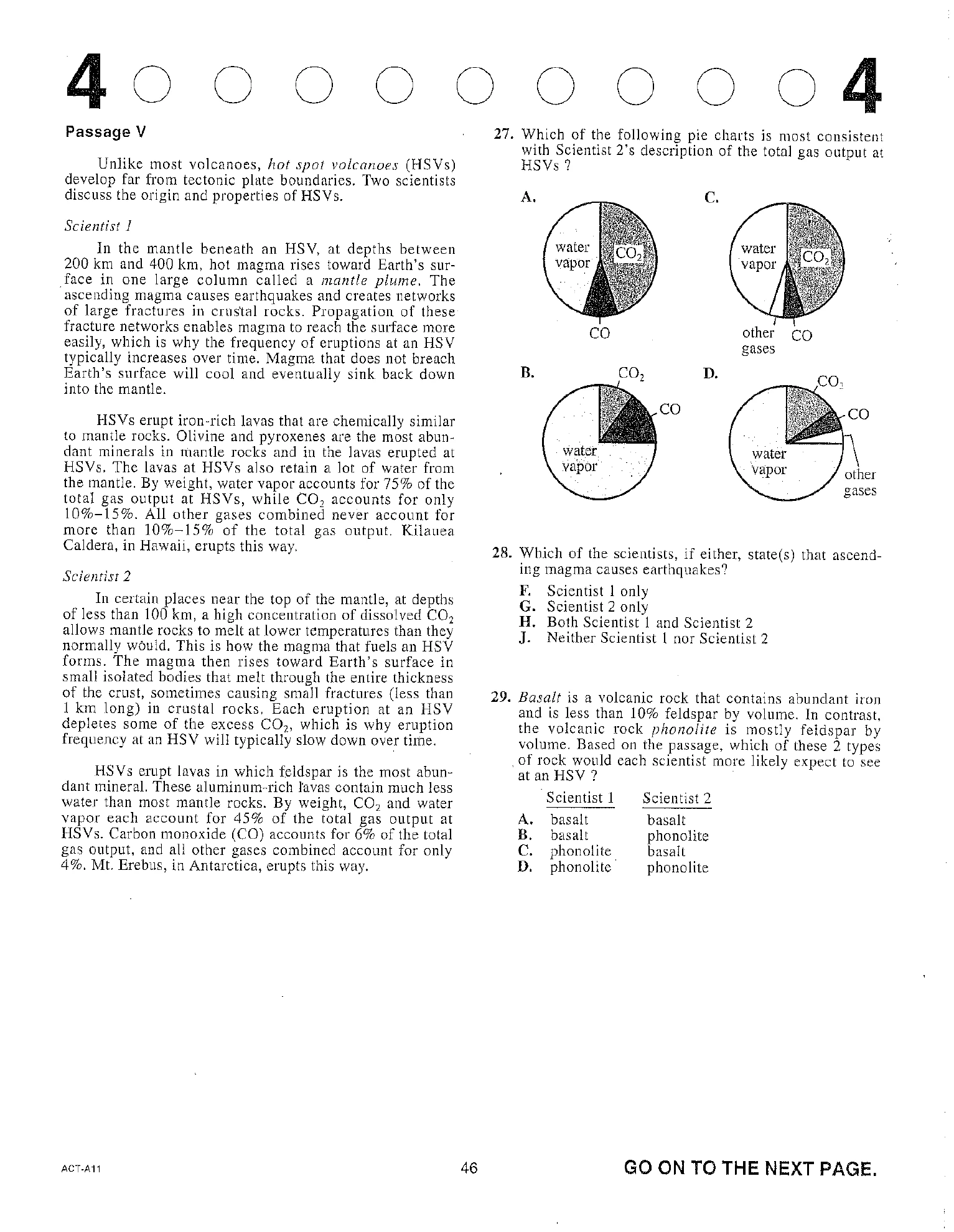
Which of the following pie cliai'lb is niost consisteiil 'ith Scieii tist 2's desci'ipLion of tlie total g<lS Olltpul al HSVS ? Unlike Inost volcLlnoes, hot spol >'olcni_'.oes i HSN:s) develop Fai. Ii'oin teLtonic pliite boundclries. Two scientiSLS disciiss the oi'igin and pi'operLies Df HSI's. Scienfist I In the mLiiiile beneath 1( n HSV, at depths bet'e-n 200 kni aiid 400 kni, hot maomlt rises toviard Earth's sur- race in one large coluiiin called a i71.qnfle pluTr.e. The ,IsceiidinoT magin2< C2£ uses e<11 Ihqu&ikes <2nd creat=s r.etworks of large frÉlCtui-es iii ciiis'tcil iocks. PIopcisatioii of ih-se fracture networks cnables miigincl to reach the suifGce more ecisily, wliich is why tlie Ii'equency of eruptlO.Iq £Lt an HSK: typically increa,ges ovei. tinie. Magma that dovs not brea= Earth's siirf2c ce will cool and eveEItUlc Ily sink back doivn into the mantle. IAiatei vapor watei" vapoi. co, co othei. co gases co, co, co FISVS eriipt Ii'on-i"ich lav?L S that ai"e chenllcdll), similar to niic iiile rocks. Olivine and pyroxenes &e the most abun- dLint Ininerals in mcllltle roclcs cind in the la'rfas erup-ec ai HSVS. The 12( vas at HSVS also i'etain a lot of wa:-er from the In¢intle. By weight, Wclter vapoi" accounts tor 75% bf the total gcls OLItPLIt at HSVS, while CO? accouii ts for onl). 10l0-15fo. All other gages combiiied never aLCOLllt for more thar] 1090-15Yo Ot the total gas oiitpuE. KilaLièa Caldera, in HclWc111, ei'upts this wa).. co Wcltei" other (Yli ses