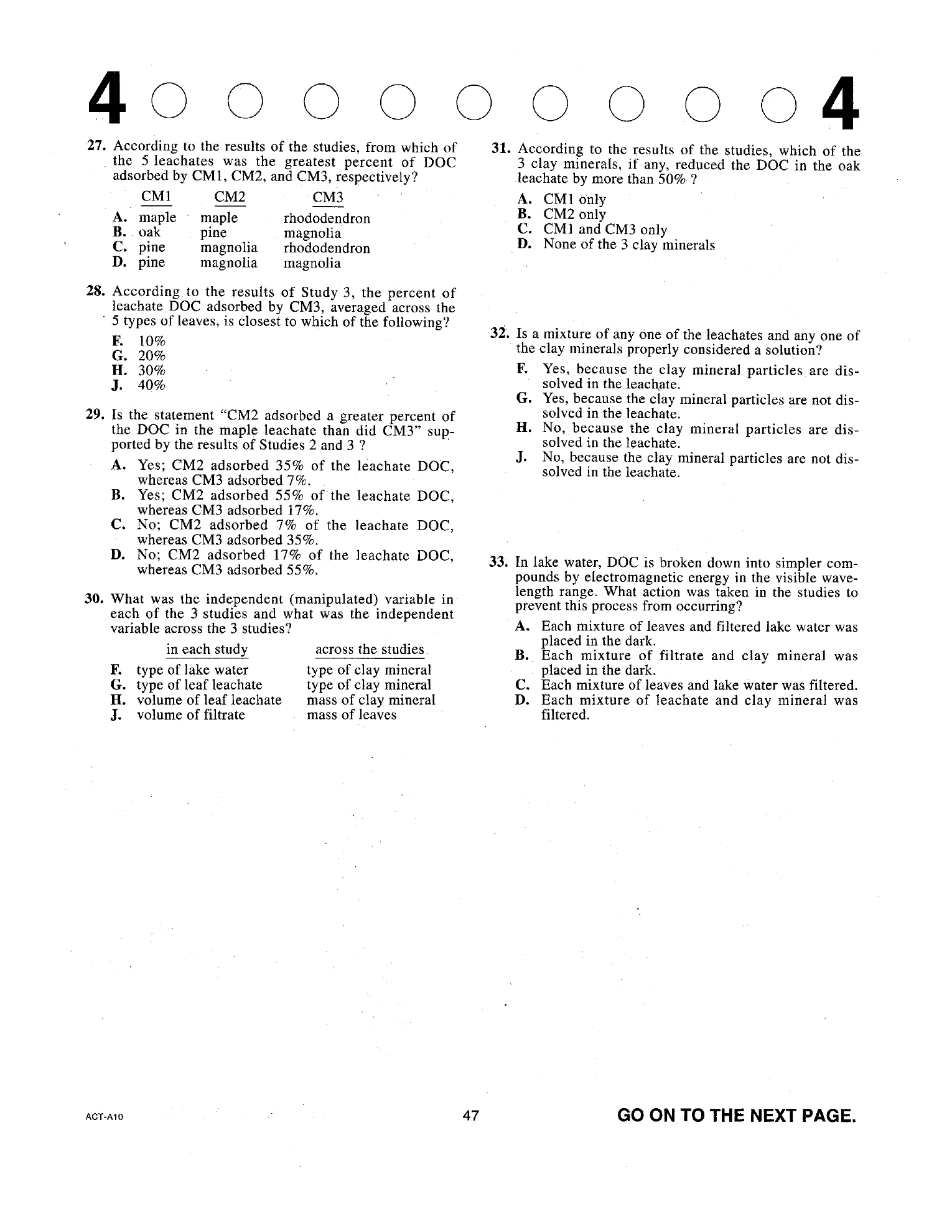
What was the indcpcndent (manipulated) variable in each of the 3 studies and what was the independent variable across the 3 studies? in each study volume of leaf leachate volumc of filtratc across the studies type of clay mineral type of clay mineral mass of clay mineral mass of leaves ACT.A10 47 GO ON TO THE NEXT PAGE. 40000000004 Pa8sage Vl Plant roots can respond to a stimulus. Response to light Is phototropism; response to gravity is gravitropism. Growth toward a stimulus is a positive tropism; growth away from a stimulus is a negative tropism. For 2 experimenis with wild-type (WT) and mutant (M) Arabidopsis seeds, nutrient agar was put into each of 8 petri dishes (PDI-PD8). Experiment I Six WT Arabidopsis seeds were placed in each of PDI and PD2. Six M Arabidopsis seeds were placed in each of PD3 and PD4. Then, PDI and PD3 were placed in the dark for 70 hr, and PD2 and PD4 were exposed to light from above for 70 hr. Figure I shows the growth of the hypocolyls (seedling stems) above the surface of the nutri- ent agar and the growth of the radicles (s¢edling roots) below the surface of the nutrient agar in each disb at 70 hr. Then, PD5 and PD7 wer¢ exposed to light from above for 25 hr while PD6 and PD8 were exposed to light from below for 25 hr. At various times during the 25 hr, thc downward curvature, in degrees (.), of the radicle (Telative to its starting position) of each seedling in each dish was measured. The average downward curvature of the Tadicles in each dish at each measurement time is shown in Figure 3. Key -o- PD5 PD6 -D-- PD7 -•-- PD8 20 40 light from above light from below nutrient agar 100 0 5 10 15 20 25 0 5 10 15 20 25 time (hr) PDI PD2 Figure 3 Figures adapted from Stanislav Vltha, Liming Zhao. and Fr8d David Sack, °Interaction of Root Gravitroplsm and Phototropism in Arabidopsis Wild-Type and Starchless Mutants." 2000 by Ameri. can Society of Plant Physiologists. PD3 PD4