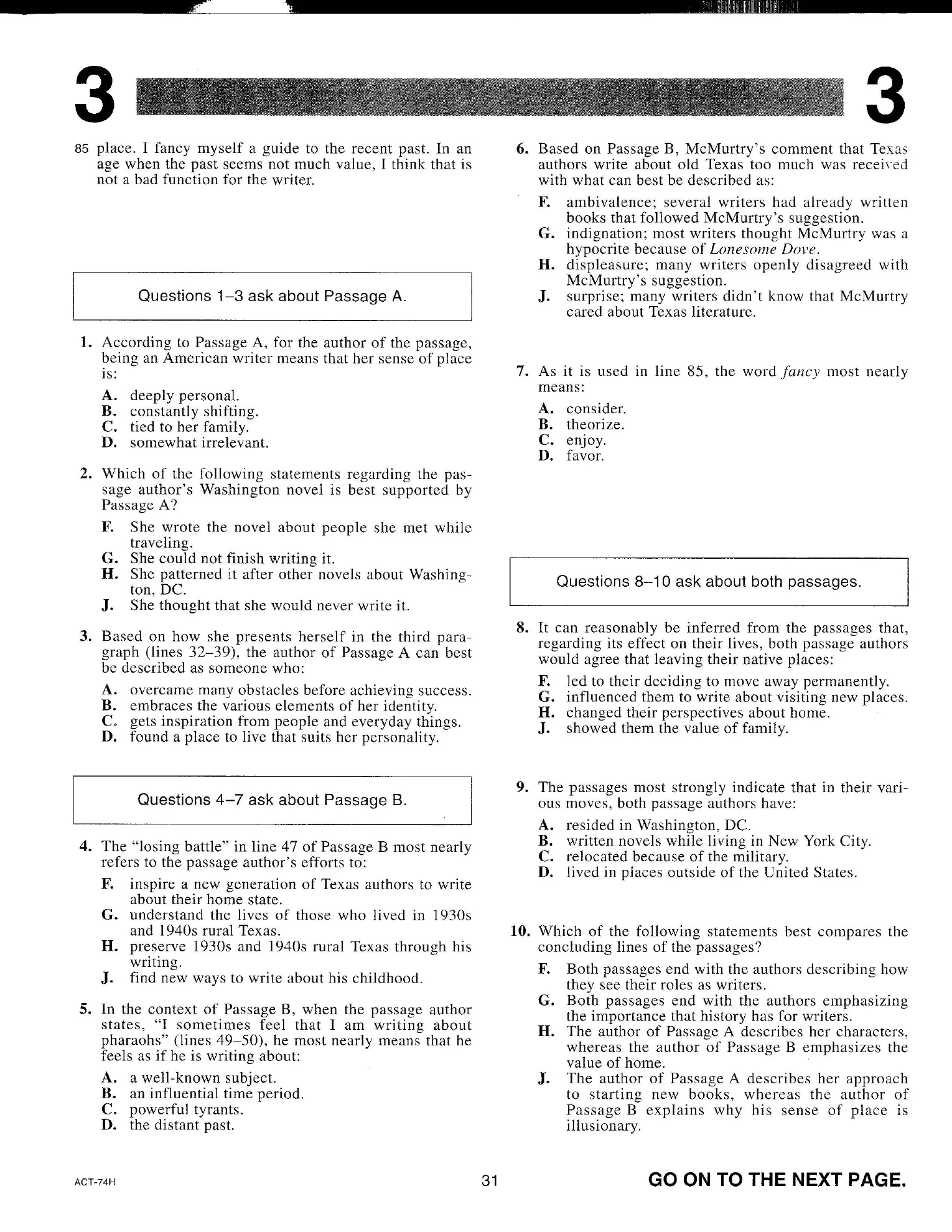
In the context of Passage B, wlien the passaqe author states, ometimes feel that I am writing about pharaoh%" jlines 49-50), he most nearly ineans that he feels as it he is writing about: a well-known subject. an iiifluential time period. ACT-74H 31 GO ON TO THE NEXT PAGE. Passage 11 55 print for more and more companies doing business on the Internet. Today, everybody is intenselv interested in understanding how communities form across distances, because that's what happens online. SOCIAL SCIENCE. This passage is adapted from the article "Management Secrets of the Grateful Dead. by Joshua Green {@2010 by The Atlantic Monthly Group). Much of the talk about "Internet business models" 60 presupposes that they are blindingly new and different. But the connection between the Internet and the Dead's business model was made years ago by the band's lyri- cist, John Perry Barlow, who became an Internet guru. In 1994, Barlow posited that in the information econ- 65 oiuy, "the best way to raise demand for your product 18 to give it away., As Barlow explained to tne. What people today are beginning to realize is what became obvious to us back then-the important correlation is the one between fan]iliarity 2nd value, not scarcity and 70 value. Adam Stnith taught that the scarcer you make something, the more valuable it becomes. In the physi- cal world, that works beautifully. But we couldn't regu- late [taping at] our shows, and you can't online. The Internet doesn't behave that way. But here's the thing: 75 if I give my song away to 20 people, and they give it to 20 people, pretty soon everybody knows mc, and my value as a creator is dramatically enhanced. That was the value proposition with the Dead., The Dead thrived for decades. in good times and bad. IN a rccession, 80 Barnes says, strategic improvisation is more important than ever. "If you're going to survive an economic downturn, you better be able to turn on a dime,, he says. "The Dead were exemplars." It can be only a matter of time until Managenzent Secrets of the Grateful 85 Dead or some similar title is flying off the shelves of airport bookstores everywhere. Since the 1970s, the Grateful Dead has invited academic examination. Musicologists showed interest, altliough the band's sprawling repertoire and tendency to improvise posed a significant challenge. Engineers 5 studied the band's sophisticated sound system, radical at the time but widely emulated today. Other disciplines have also found relevant elements of the band's history and cultural impact to be worth exan]ining. Oddly enough, the Dead's influence on the busi- 10 nes% woi.ld may turn out to be a significant part of its legacy. Without intendlllg to-while intending, in fact, to do just the opposite-the band pioneered ideas and practices that were subsequently embraced by corporate America. One was to focus intensely on its most loyal 15 fans. It established a telephone hotline to alert them to its touring schedule ahead of any public announcement, resei.ved for them some of the best seats in the house, and capped the price of tickets, which the band distrib- uted through its own mail-order house. If you lived in 20 New York and wanted to see a show in Seattle, you didn't have to travel there to get tickets-and you could get really good tickets, without even camping out. "The Dead were masters of creating and delivering superior ciistomer value,, Barry Barnes, a business professor at 25 Nova Southeastern University, in Florida, told me. Treating customers well may sound like common sense. But it I"epresented a break from the top-down ethos of many oruanizations in the 1960s and 1970s. Only in the 1980s, faced with competition from Japan, did Ameri- 30 can CEOS and management theorists widely adopt a customei'_fir%t orientation. As Barnes and other scholars note, the musicians who constituted the Dead were anything but naive Iboul their business. They incorporated early on, and 35 established a board of directors (with a rotating CEO position) consisting of the band, road crew, and other members of the Dead organization. They founded a profitable merchandising division and, peace and love notwithstanding, did not hesitate to sue those who vio- 40 lated their copyrights. But they weren't oreedy, and they adapted well. They famously permitted fans to tape theii shows, ceding a major revenue source in poteiilial record sales. According Lo Barnes, the deci- sion wa.g not entirely selfless: it reflected a shrewd 45 assessment that tape sharing would widen their audi- ence, a ban would be unenforceable, and anyone inclined to tape a show would probably spend money el8ewhere, such as on merchandise or tickets. The Dead became one of the most profitable bands of all time.