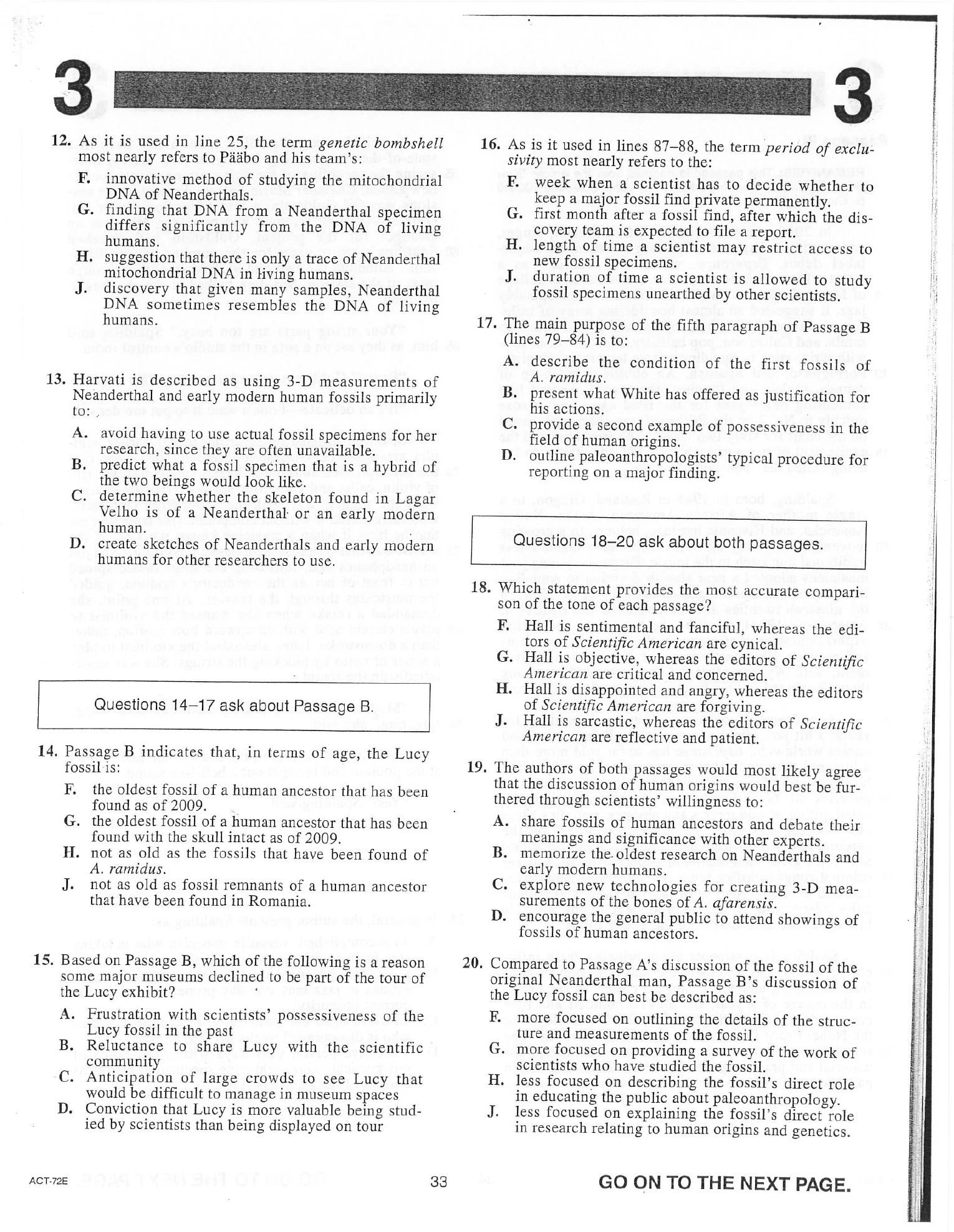
Compaied to Passage A's discussion of the fossil of the original Neanderthal mail, Passage B's discussion of Ihe Lucy fossil can best be described as: more focused on outlining the details of the struc- ture and measurements of the fossil. niore focused on providing a survey of the work of scientists who have studied the fossil. in educating the public about paleoanthropology. in reseaich relating to human origins and genetics. ACT-72E 33 GO ON TO THE NEXT PAGE. Passage111 In rnid-january, Spalding spent a few days in a state-of-the-art recording facility in New Jersey, over- 55 seeing the recording of the string arrangements for her new album, Chamber Music Society. Present at the ses- sions was Gil Goldstein, a jazz accordion player and Grammy-winning arranger and pi'oducer. Hired as an arranger for the project, Goldstein had twcaked 60 Spalding's string parts for the number "Apple Blos- som., Although the two had worked smoothly through most of the session, Spalding balked at the changes to the song. HUMANITIES: This passage is adapted from the articl8 "New Note: Esperanza Spalding's Music" by John Colapinto (Q2010 by Conda Nast). In 2008, thé prodigiously gifted bassist, singer, and composer Esperanza SpaIding released her major- label .début, Esperaizza, which she recorded as a twenty-thTee-year-old instructor at the Berklee College 5 of Music, in Boston. While the inusic was indisputably jazz, it suggested an alinost bewildering aFray of influ- ences fusion, funk, soul, rhythm and blues, Brazilian samba and Cuban soil, pop bajladry, chanted vocalese- with lyrics sung in Spalding's three languages., English, 10 Portuguese, and Spallish. An ebullient mash-up of sounds, styles, and tongues, the record seeined like soincthing ncw-jazz tor the iPod age-and it rose quickly to ,0. 3 on the Billboap'd jazz chart, and staycd on the chart for sixty-two weeks. The freshness and the 15 excilement of her approach hdve led, inevitably, to her being called tlie "new hope for ja7.7..' 'Your string parts are too busy." Spalding told 65 him, ds they sat on a sofa in the studio's control room. "Busy? Goldstein echoed, laugliing. "No way. 'It's so delicate-I don't want it to get too dcnse." ,8palding insisted on reverting to her earlier, sim- pler arrangement. Gold.stEiIi as.seiited, tlien weiit into 70 the soundproofcd studio and bcgan conductiiicr the trio of violin, cello, and viola. But Spalding ivas not hcaring what she wanted. She took the baton from Goldstein, WIIO SLirreiiLlered IL wiihouL cornplaint. (He later told me that he likes it when a Inii,siciaii kiiows wliat lie ur she 75 wants, and that it makcs for a bcttcr recording.) ,qlie put on headphones and, following the shcct music sprcad out in front of her on the conductor's podium, guided tlie iilLISILl¢ins Lhrou¥h the session. Ai one poini, she demanded a retake wlieii slie. waiited ilie vivliiiisL Iu 80 play a ccrtain. note with an upwai'd how niot1013, ratlie than a downstrokc. Latci., she askcd thc violini.8t to play a series of notes by pluckin(T the strings. Shc was unsat- isfied with Lhe sound. SpaldÈno born in 1984 in Portland, Oregon, to a single mother of African American, Asian, Native AmeriL(In, dnd Hispanic heritage, belongs to a growing 20 iiioveiment nf yoiing illLisicians wlio liave tdkeLI a less traditional approach to thc music. for years, young ja7Z musicians adopted a ncar 8Iavish devotion to sounding like players from jazz's golden ane (anywhere between the nineLeen-twenties and the arrival of the Beailes in 25 Americci, in 1964), rejecling ihe pop, rL)ck, dnd fusion experimentatinn tliat. caiiie iii the iiiiieteeii-.seveiities and cightics. 'I'hc mcmbcrs ot thc Young Lions movc- ment, with Wynton Marsalis the most visible among them, feiishized staunchly noncommercial "pure" jazz. 30 Aitendc1nce at ja7.7. concert.s has be.en declining for ycars; a hit jazz album today niight sell forty thousand copies worldwide. Espera7iza has so ftlr sold rnorc than a hundred thousand. This is, in part, because Spalding hews clogeT to dance rhythms than many of her contem- 35 porai'ies do. (TazT. lias becosiie iiicreasingly Lonipli- cated, piling on odd mctcrs and ab,strllse melodies.) It is also bec&use she sings; for audieiiccs put off by the cerebral rigois of instrurnental improvisation, her pliant alto voice giiies them something to hang on 10. But her 40 01-igiiial sorigs sacrifice noiie of the nieludic supliistica- tion and harmonic interest of jazz; and she is a.s tcchni- cally adept, and as serious a student of the music's history, as the most dutiful of the Young Lions. 'Maybe make that i)luck"ing Inoi'e like bells 85 ting, ting,, shc said. li17y, The violinist rnimicked the moiion she had mimed at tlie podiLliii and broughi oul <1 bell-like sound. 'Yesl?? Spalding said.