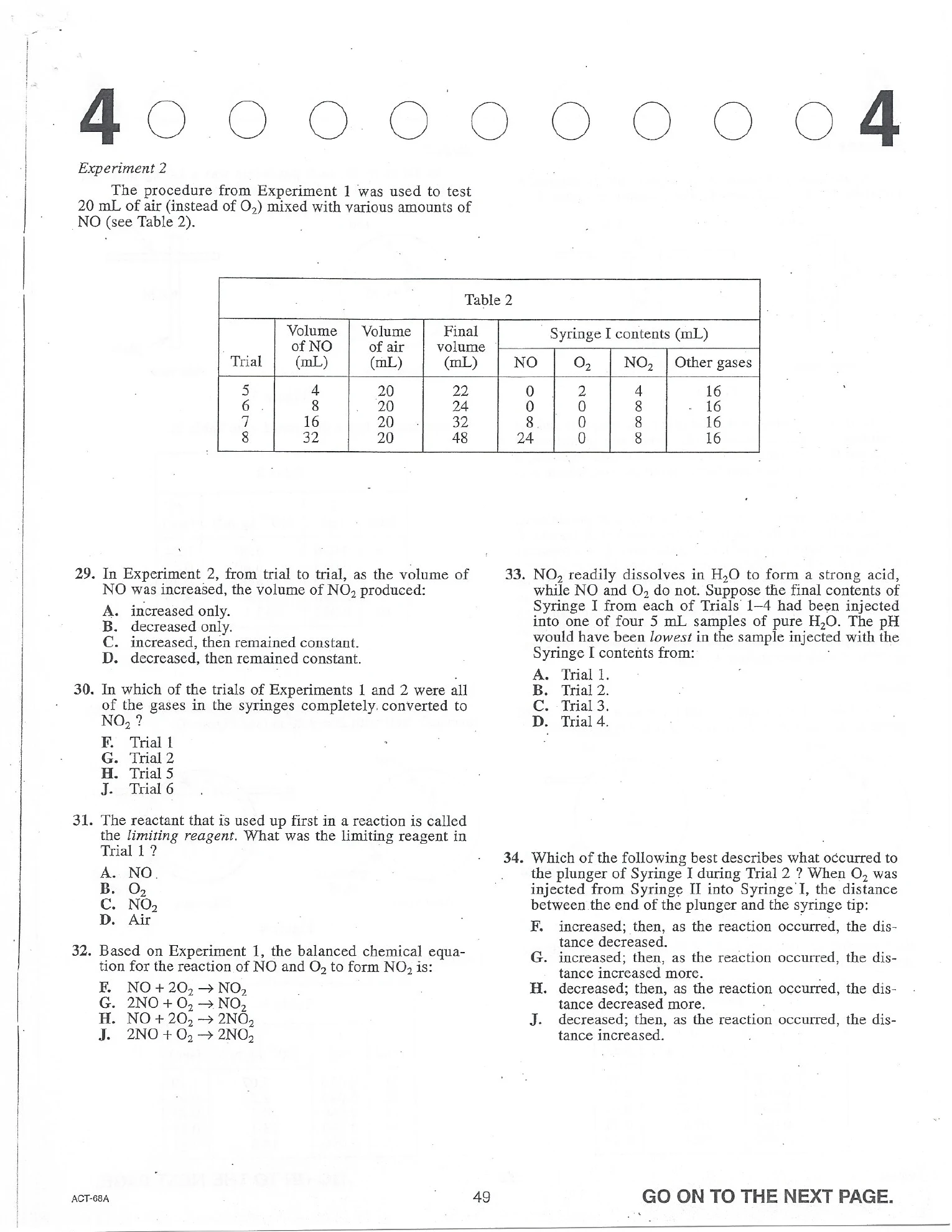
Based on Experiment l. the balanced chemical equa- tion for the reaction of NO and 02 to form NO2 IS: 2N0 + 02 -> 2N0 ACT-68A 49 GO ON TO THE NEXT PAGE. Passage.Vll SIudy 2 A physiGal pendulum is an object that is suspended vertically from a ricTid support (see example kn Fi(rure l). rod Tiials 6-10, each pendlllum was a 1.0 kg thin, flat circular plate with D = 0.20 m (sce Figure 3). rod rod •CM CM CM pl&te plate front view side view front view side view Figure I Figure 3 L is the distance between the rod (the rigid support) and the penduluin's center of mass (CM). When the pendulutll is displaced from its eqllilibrium position and then released, it oscillates (swintrs back and forth) about the rod, which acts as the axis of rotatiOII. Each pendulum had a different L (see Table 2). Table 2 Students tested several types of physical pendulllll]s. In each trial, first, they computed the 0ent of inertia, I, in kilogram meters (kg m ), of a pendulum. (l is a measure of the mass of a pendulum and how the mass is distrib- uted.) Next, they displaced the pendulum slightly fToD] its equilibrillm position, rcleascd it, and measured the time, in seconds, it took the pendulum to oscillate through 20 cycles (I cycle is I round-trip back and forth). Finally, they computed the pendulum's average period, P (the aver- age time it took to complete I cycle). Tiial (m) (10-, kg m,) (sec) 10 Study I In Trials 1-5, each pendulum was a 1.0 kg solid sphere with a diaineter, D, of 0.20 m (see Figure 2). rod Srudy 3 In Trials 11-15, each pendulum was a 1.0 kg thin, spherical shell with D = 0.20 m (see Figure 4). rod rod CM soIid sphere solid sphere spherical shell spherical shell front view side view front view side view Figure 2 Figure 4 Each pendulum, however, had a different L. The results are showll ill Table l. Each pelldulum had a different L (see Table 3). Table I Table 3 Trial (m) (10-, kg m,) (sec) Trial (m) (10-, kg m,) (sec) 12 13 14 .15 ACT-68A 50 GO ON TO THE NEXT PAGE. 000000000