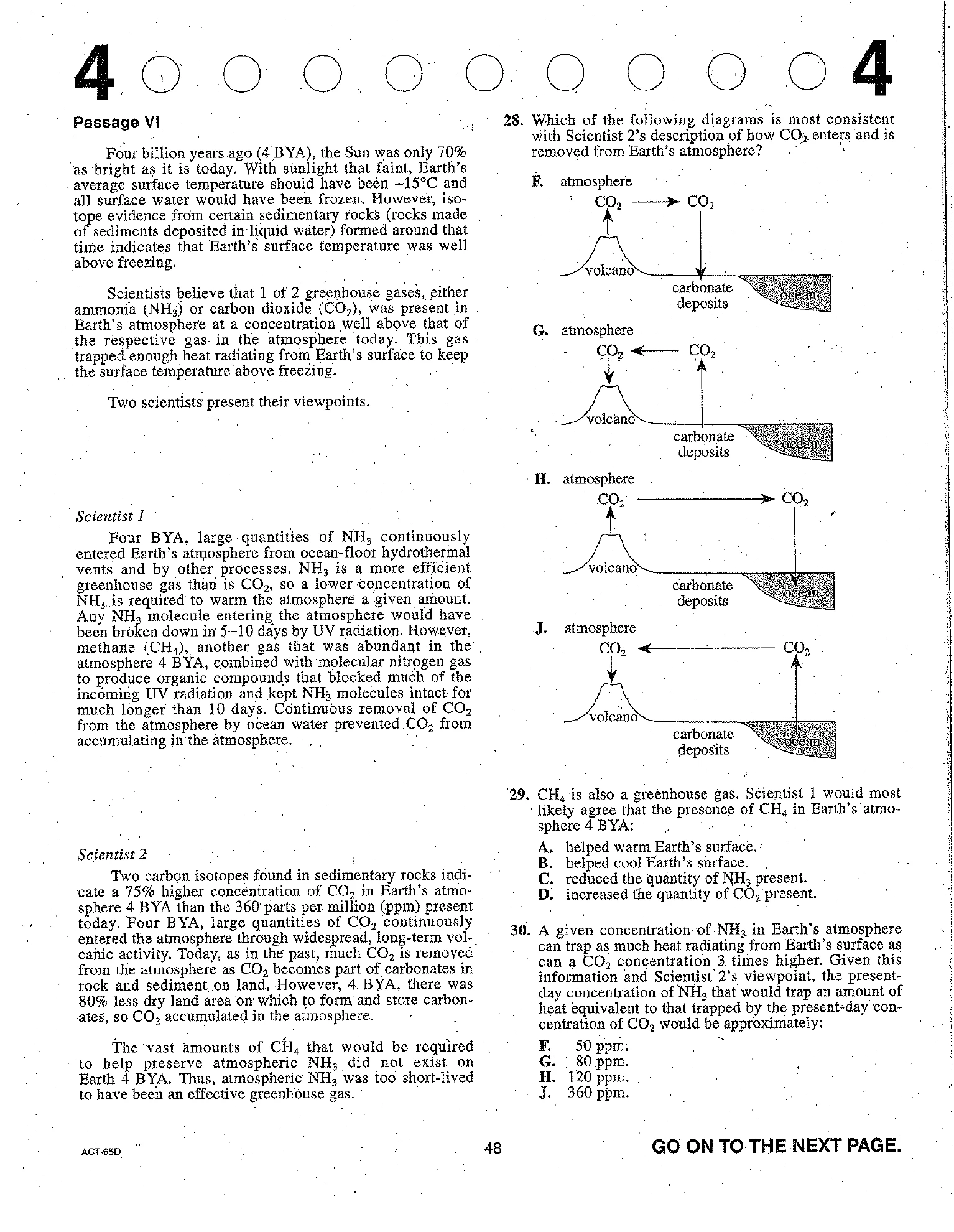
w.hich of the following diagrams is most consistent with Scientist 2's description of how CO2 enteTS and is removed from Earth's atmosphere? atmosphere CO, --> CO, Four billion years.ago (4 B YA), the Sun was only 70go as bright as it ks today, With sunlight that faint, Earth's average surface temperature should have been -15°C and all surface water would have been frozen.. Howevei, iso- tope evidence from cert&in sedirnentary rocks (rocks madc of sediments deposited in liquid water) fonned axound that time indicates that Earth's surface temperature was well above freezing. Scientists believe that l of 2 greenhouse gases, either ammonia (NH3) or carbon dioxide (CO ), was present in Earth's atmospher'¢ at a concentration well above that of the respective gas in the atxnosphere today. This gas trapped enough heat radiating from Earth, s surf'ace to keep the surface temperature above freezing. carbonatc deposits atmosphere Two scientists present their viewpoints. volcano carbonate deposits , H. atmosphere co, Scientist I Four BYA, large quantities of NH3 continuollsly entered Earth's atEnosphere from ocean-floor hydrothermal vents and by other processes. NH3 is a more efficient greenhouse gas than is CO , so a lower concentration of NH3 18 required to warm the aimosphere a given ainount. Any NH3 molecule entering. the atniosphere would have been bToken down in 5-1 O days by UV radiatlOD. HoweveT, methane (CH4),. ¬her gas that was abundant in the atmosphere 4 B YA, combined with molecular nitrogen gas to produce organic compounds that blocked much of the incoming UV radiation and kept NH3 njolecules intact for much longer than 10 days. Continuous removal of CO from the atmosphere by ocean water prevented CO from accuinulating in the atsnosphere. volcano carbonate deposits atmosphere co, volcano carbonate deposits