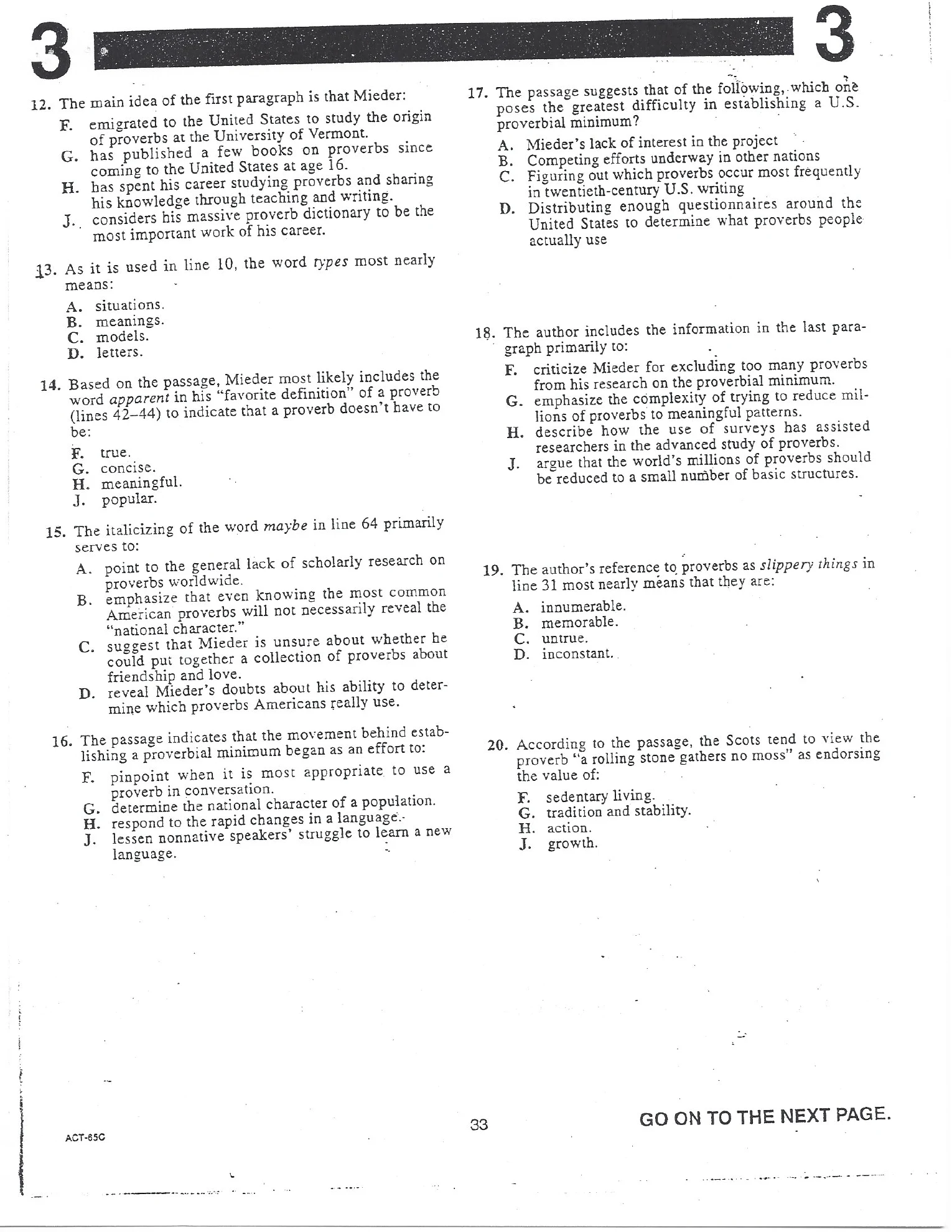
According (o the passaoe, the Scots tend to I'iew the pioverb 'a rolling stolle gathers no ukoss" as endorsintr the value of: sedentary livin£. tradition and stability. action. growib. 33 GO ON TO THE NEXT PAGE. A¢T-65C Passage 111 55 glass is not only 5peciaculaT EO look at and throutrh, it is also more efficient and much safer than the old glass. Stringent ener?y codes hai'e led to manv innoi'ations. Glass is now being manufactured Thith special coatinos that adjust the thermal in£ake for all four. dLrectiot15 of 60 the compass and el'en allow for Lhe increased inten521 of Ihe sun at certain latitudes. For the ne L),-H (Louis Vuitton Moet Hennessy) buildinc, which opened in midtoThn Manhattan in 1999, more than 30 diffeieni tvpes of glass were used in Ihe curiain 'all in order ÉO 65 rneet New York Cily's eneigy c.odes and crtaie arresling facade of contrastintr tCX¥ures and color5. Old glass buildin05, too, are benefiiing fron Ihe improvemellts in glass. Cornpleied in 19)2. Pa-, Avenue's Leiter House as one of the first glass-Th:alle 70 buildings in Manhatian. Con5trucLion ts'as recently fiv,- ished on a two-year renovation. undertaken because Ihe original glass had beoun 10 crack. The siiucture has now been completel}. reclad with a new, strontrer ver- sion of the glass oriuinally used in the buildin 'Glass is being artsued as a new toaterial,, notes architect Robert A. Nl. Siern, dean of the School o Archiieciure at Yale University. "Il's being rediscoi'_ ered afier i generation OF architects who rejected.it." HUMANITIES: Thls paosage is ada?t?d fron the article Ascent of Glass" by JeNrey Hogrefe (Q2001 by the Smilhson- ian I nstitulion)- One of Ihe mosi striking of Ihe uansparent glass buildinos Ihat are appearing like trh05tly apparilions in cities around Ihe woIld, Ihe Rose Center for Earth and Space ai the American Museum of NTatLlr&l HisLory s NIanhatian marks a new age in olass architeciure. i 01 since the early 1950s, w'hen rleek, greei-iip.ied glass buildings Like New. York Cit}':s Lever House rose arnid the stone canyons of couniless Vlajor cities, has trlass elicited so much 21lention. Therc ar- so ]nany glass 10 buildings currentlv on the drawling boards or under con- strucLion. in fact, thai it is hard 10 keep unacL of the all. "Glass is back,. savs Kenneth FramptDn, professor of architeciure ai Columbia UniTr'ersity and author of Moderpz Architecft4re.' A Critical Hisror>. And now il's 15 takino cenier stage. Like Ihe Rose Ceniei, many of Ihe new glass edi- fices a=e sionatuie buildiniys. That is to sa!.: Ihe szllLC- ture itself is used to communicate a message to the public about tbe occupan(s' underlying philosophies. 20 -3I'e 'anted to build a structure that would sa) 5Ci- ence. says Rose Center lead desi(Tner James Polshek. In Ihe J'eai Since the Rose Center opened 10 the public, ir dreK' croN:ds be>'ond the 4:ildest eipect21jons of the museum's directors, Nlan}' people co just to see the 25 pfisLii& e olass cub: hich houses the Spherial alu- minum Hayden Planetarium a5 if il were a ship in 2 giant glass boitle. The museutn's directors w'ere ini- tiallN relTJciant to L7ive the oreen lighL to such an experi- merJi&l qJsten] of glass construction because nothinoy 30 like IE had been used here in ihe Llnited States. Althou(Th rnany of ihe icons of early gl- <s archiieciure rosc in U.S. cities during the )'ears afier World IN'ar II. since ihe energy crisis of 1973 mosl of the advances in glass archiiecture have taken place in Europe. The 35 direciors approved the design only after a irip 10 France 10 See the buildino's prototype, the Clié de Sciences & I'IndusErie, in Paris. Cotnpleied in 1986. th= museu Used an innovacive structural dei'ice desioned by the Paris-b2sed firtn of Rice FIancis Ritchie. The s)'SLera 40 suspended the (rl&ss wall in front of a series of meial tru55¢5 and braces thai held Ihe glass panels in a state of tension. 75 Glass can serve as a lens, rei'ealiTro and brinill 80 in*0 focus ihe inierior of buildings as in the Ro<e Cenier, and in the award-winnino Hillier Group desi£n for the poiier plant that supplies eleciricil! to N'eil. Tr'ork's John F. Kenned), InternaiiDnal Airport. TFie inoer w'orLings of the plant are exposed 10 i'le. throjob, 85 the buildinr's Eransparent ulass walls. Linlike tradi- iional poThei pl ants, w'hich disouise thernselN'es as oihei types of bu31dinus, the IFK design is as honesÈ as it Ts bold. 'The underlying point of the destgn 'a8 Ih?t PO.er is be2uiiful,' sai-s pioject architect DaNid Finc". Gla55 has many i'irtues. It lets in IiLTht, and brings the outside in and the inside out. Glass is also itnperTri- 45 OU5 to the effects of rnosi harsb chernicals and thus is less susceptibl= 10 damatTe from acid rain, which eats aLTr ay at Tryasonry buildinos. Furthermore, advancemenis in trlass production since ihe 1973 energy crisis have resulted in revoluEionary changes In Its performance. KenneEh Frampton sees the return to trlass build- intrs as a s}'mbol of progress. "We do see glass co.illg back, 2nd with Ihc cotneback it has to be efieccive eniij- iorLmentall} he says. 'The early glass curlain wall 14.as only sliohtly more efficient than no 'all., The new