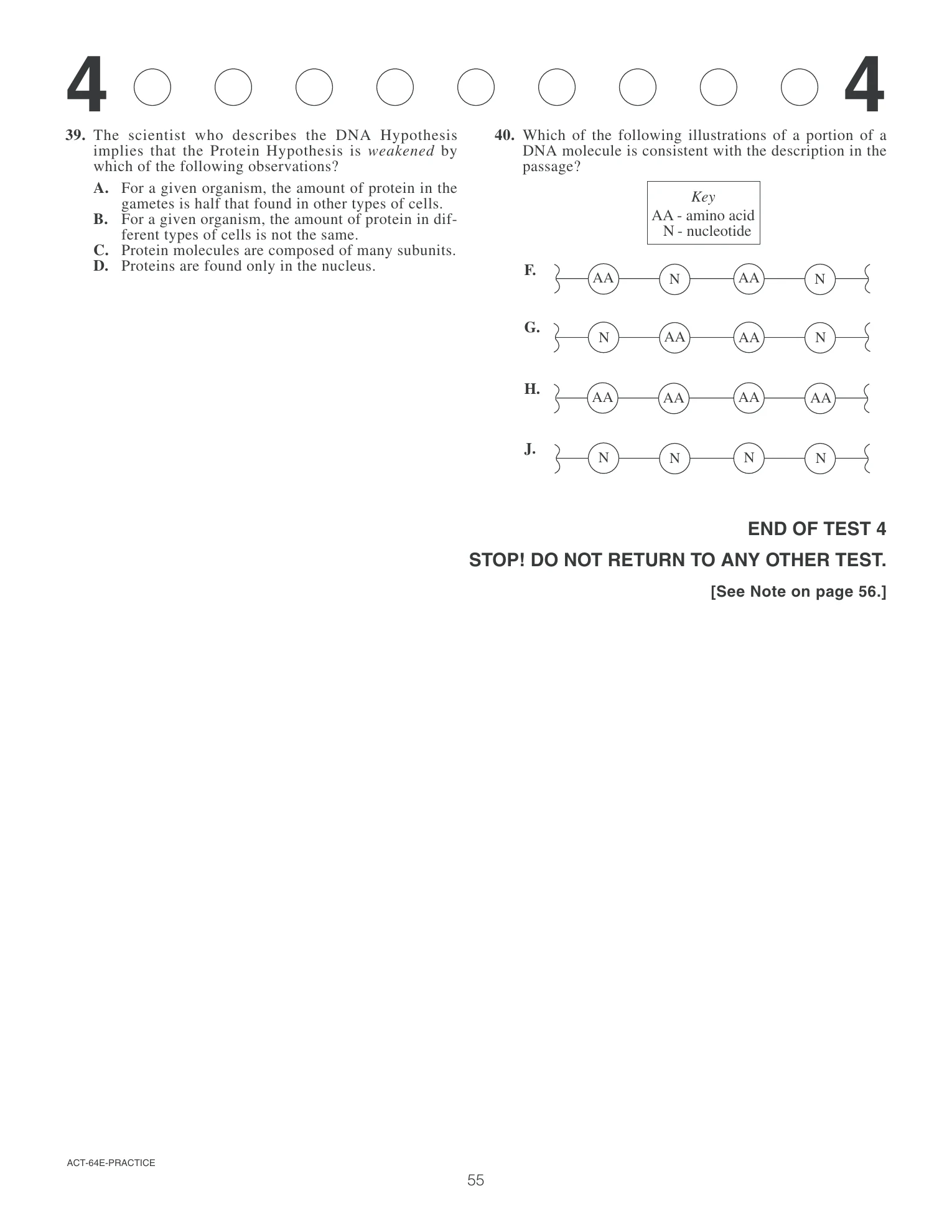
Which of the following illustrations of a portion of a DNA molecule is consistent with the description in the passage? AA N N N N N N AA AA AA AA AA AA AA N N Key AA- amino acid N- nucleotide 4 4 END OF TEST 4 STOP! DO NOT RETURN TO ANY OTHER TEST. ACT-64E-PRACTICE 55 [See Note on page 56.] 56 If you plan to take the ACT Plus Writing, sharpen your pencils and continue with the Writing Test on page 57. If you do not plan to take the ACT Plus Writing, skip to page 59 for instructions on scoring your multiple-choice tests. 57 Practice Writing T est Form 13G WritingTest Booklet Your Signature (do not print): Print Your Name Here: Your Date of Birth: Month Day Year ©2009 by ACT, Inc. All rights reserved. NOTE: This booklet is covered by Federal copyright laws that prohibit the reproduction of the test questions without the express, written permission of ACT, Inc. P.O. BOX 168 IOWA CITY, IA 52243-0168 Directions This is a test of your writing skills. You will have thirty (30) minutes to write an essay in English. Before you begin planning and writing your essay, read the writing prompt carefully to understand exactly what you are being asked to do. Your essay will be evaluated on the evidence it provides of your ability to express judgments by taking a position on the issue in the writing prompt; to maintain a focus on the topic throughout the essay; to develop a position by using logical reasoning and by supporting your ideas; to organize ideas in a logical way; and to use language clearly and effectively according to the conventions of standard written English. You may use the unlined pages in this test booklet to plan your essay. These pageswillnotbescored.Youmustwriteyouressayinpencilonthelinedpages in the answer folder. Your writing on those lined pages will be scored. You may not need all the lined pages, but to ensure you have enough room to finish, do NOT skip lines. You may write corrections or additions neatly between the lines of your essay, but do NOT write in the margins of the lined pages. Illegible essays cannot be scored, so you must write (or print) clearly. If you finish before time is called, you may review your work. Lay your pencil down immediately when time is called. DO NOT OPEN THIS BOOKLET UNTIL TOLD TO DO SO. You must take the multiple-choice tests before you take the Writing Test. ACT Writing T est Prompt Note • Your test booklet will have blank space for you to plan your essay. For this practice test, use scratch paper. • You may wish to remove pages 75–78 to respond to this prompt. • When you have completed your essay, read pages 66–72 for information and instructions on scoring your practice Writing Test. ACT-13G-PRACTICE 58 At some high schools, teachers have considered allowing each student to choose the books he or she will read for English class rather than requiring all students in class to read the same books. Some teachers support such a policy because they think students will greatly improve their reading skills if they read books they find interesting. Other teachers do not support such a policy because they think that students will learn more by participating in class discussion with others who have read the same books. In your opinion, should each individual student be allowed to choose the books he or she reads for English class? In your essay, take a position on this question. You may write about either one of the two points of view given, or you may present a different point of view on this question. Use specific reasons and examples to support your position. 59 5Scoring Your Tests How to Score the Multiple-Choice Tests Follow the instructions below and on the following pages to score your practice multiple-choice tests and to evaluate your performance. Raw Scores The number of questions you answered correctly on each test and in each subscore area is your raw score. Because there are many forms of the ACT, each containing different questions, some forms will be slightly easier (and some slightly harder) than others. A raw score of 67 on one form of the English Test, for example, may be about as difficult to earn as a raw score of 70 on another form of that test. To compute your raw scores, check your answers with the scoring keys on pages 60–62. Count the number of correct answers for each of the four tests and seven subscore areas, and enter the number in the blanks provided on those pages. These numbers are your raw scores on the tests and subscore areas. Scale Scores To adjust for the small differences that occur among different forms of the ACT, the raw scores for tests and subscore areas are converted into scale scores. Scale scores are printed on the reports sent to you and your college and scholarship choices. When your raw scores are converted into scale scores, it becomes possible to compare your scores with those of examinees who took different test forms. For example, a scale score of 26 on the English Test has the same meaning regardless of the form of the ACT on which it is based. To determine the scale scores corresponding to your raw scores on the practice test, use the score conversion tables on pages 63–64. Table 1 on page 63 shows the raw-to-scale score conversions for each test, and Table 2 on page 64 shows the raw-to-scale score conversions for the subscore areas. Because each form of the ACT is unique, each form has somewhat different conversion tables. Consequently, these tables provide only approximations of the raw-to-scale score conversions that would apply if a different form of the ACT were taken. Therefore, the scale scores obtained from the practice tests don’t match precisely the scale scores received from an actual administration of the ACT. Computing the Composite Score The Composite score is the average of the four scale scores in English, Mathematics, Reading, and Science. If you left any of these tests blank, do not calculate a Composite score. If you take the ACT Plus Writing, your Writing results do not affect your Composite score. Comparing Your Scores Even scale scores don’t tell the whole story of your test performance. You may want to know how your scores compare to the scores of other students who took the ACT. The multiple-choice norms table (Table 3A on page 65) enables you to compare your scores on the practice multiple-choice tests with the scores of recent high school graduates who took the ACT. The numbers reported in Table 3A are cumulative percents. A cumulative percent is the percent of students who scored at or below a given score. For example, a Composite score of 20 has a cumulative percent of 48. This means that 48% of the ACT- tested high school students had a Composite score of 20 or lower. Remember that your scores and percent at or below on the practice test are only estimates of the scores that you will obtain during an actual administration of the ACT. Test scores are only one indicator of your level of academic knowledge and skills. Consider your scores in connection with your grades, your performance in outside activities, and your career interests. College Readiness Standards™ To add to the information you receive about your performance on the ACT, we have developed College Readiness Standards. These standards help you to more fully understand what your total test score means for each academic area assessed: English, Mathematics, Reading, Science, and Writing. The College Readiness Standards describe the types of skills, strategies, and understandings you will need to make a successful transition from high school to college. For English, Mathematics, Reading, and Science, standards are provided for six score ranges that reflect the progression and complexity of the skills in each of the academic areas measured by the ACT tests. For Writing, standards are provided for five score ranges. The College Readiness Standards and benchmark scores for each test can be found at www.act.org/standard. Reviewing Your Performance on the Practice Multiple-Choice Tests After you have determined your scale scores, consider the following as you evaluate your performance. • Did you run out of time? If so, reread the information in this booklet on pacing yourself. Perhaps you need to adjust the way you used your time in responding to the questions. It is to your advantage to answer every question. There is no penalty for guessing. • Did you spend too much time trying to understand the directions for the tests? The directions for the practice tests are the same directions that will appear in your test booklet on test day. Make sure you understand them now, so you won’t have to spend too much time studying them on test day. • Review the questions that you missed. Did you select a response that was an incomplete answer or that did not directly respond to the question being asked? Try to figure out what you overlooked in answering the questions. • Did a particular type of question confuse you? Did the questions you missed come from a particular subscore area? In reviewing your responses, check to see whether a particular type of question or a particular subscore area was more difficult for you or took more time. 60 Scoring Keys for the ACT Practice Tests Use the scoring key for each test to score your answer document for the multiple-choice tests. Mark a “1” in the blank for each question you answered correctly. Add up the numbers in each subscore area and enter the total number correct for each subscore area in the blanks provided. Also enter the total number correct for each test in the blanks provided. The total number correct for each test is the sum of the number correct in each subscore area. Test 1: English—Scoring Key Subscore Area* Key UM RH