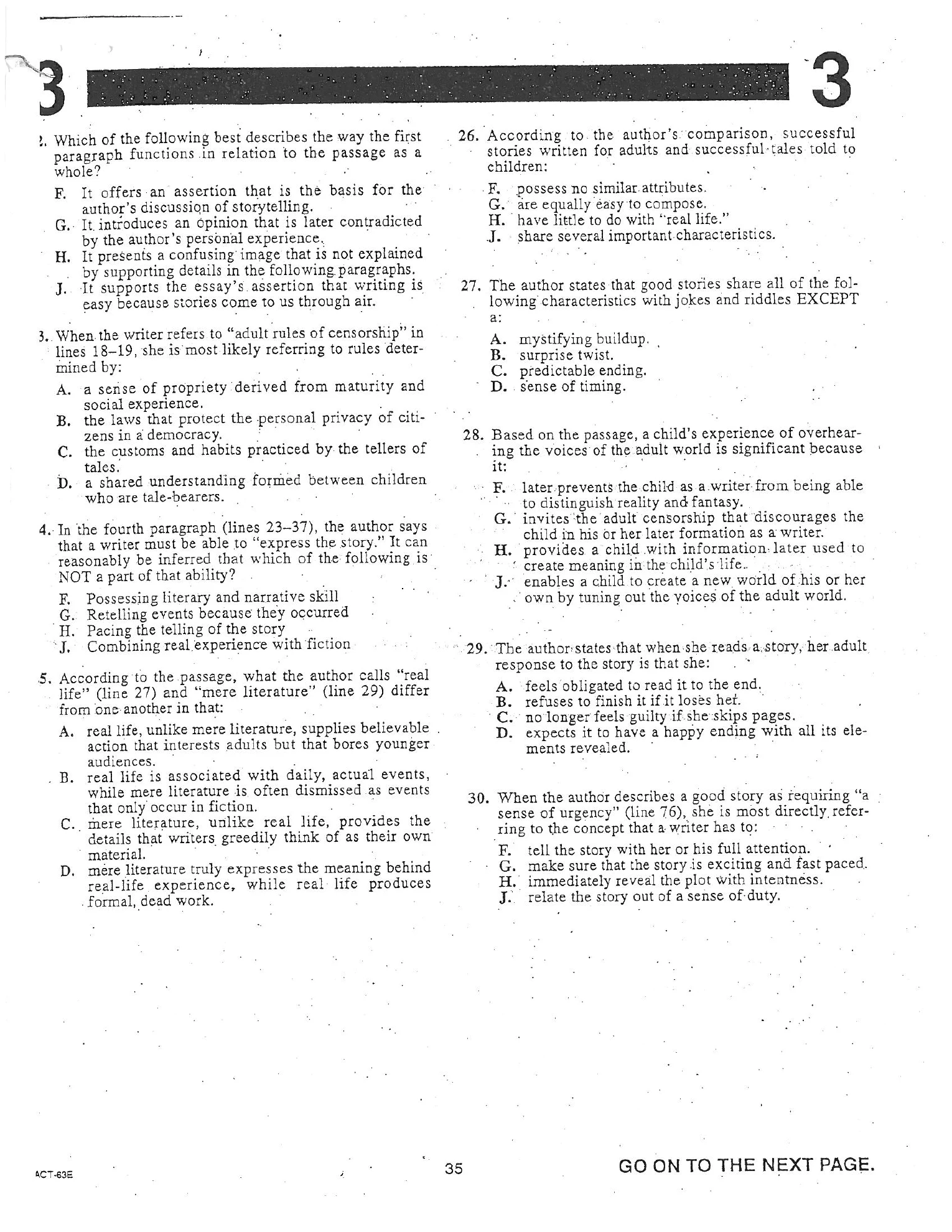
When the author deswribes a oood story as requirillg "a sense of urgency (line 76), shè is most directly. refer- ring to the concept that &. writer has to: tclL the story with her or his fuLI attention. make sure that Lhe story.is exciring and fast paced. immediately reveal the plot with intcntness. relate the story out of a sens¢ of.duty. ACT43E 35 GO ON TO THE NEXT PAGE. Passage IV NATURAL SCIENCE: This passage is adapted from Just Six Numbers.. The Deep Force6 fhat Shape the Universo by Marlln Rees (@2000 by Martin Fleès). The Sun is fuelled by conversion of hydrocTen (the simplest atom, whose nucleus consists of one proton) into helilllli (the seeond-simplest nucleus, consistintr of two prDtons and iwo neutrons). Attempts to harness 5 fusion as a power source ('controlled fusion,) have so f ar been styLnièd by the difficulty of achieving the req" ' uisite temperatures of many millions of degrees. It is even rnoie'of a'probleLn to confinè this ulLra-hot gas physically in.a laboratory it would obviously melt any 10 solid ¢ontailler and it has instead to be.trapped by magnetic forces. Rut the Sun is so massive thac gravity holds down the overlying cooler layers, and thereby 'keeps the Lid on, the high-pressure core. The Sun has adjusted its structure so that nuclear power is generated 15 Lfi the Core,. and diffuses outward, at just the rate needed to balance. the heat lost from the surface-heat tbat is the basis foi life on Earth. This fueL bas kept the Sun shining for nearly five billion years. But when it st&rts to',run out,'in another 20 five biLlion years or so,. the. Sun's.'coie will contract, and the Outer layers expand. For a hundred Tnillion years a biief 'interval relative to its overalL lifetime the Sun will brighten up and expand into the kind of star. kuown as a 'ied giant,, enouLfing the inner planets 25 and vaporizing any lif& that remains on Earth. Some of. its.outer layers will be blown off, bt the core will then setile down as a whire dwarf, sbininu with a dull blue gloKv, no biighcer than a fulI today, on the parched remaius of the Solar Systen. Astrophysicists have computed what the insidé of our Sun should be like, atld bavc achieved a gratifying fit wilh its observed radius, brightness, iemperature and ' so foith. They can tell us confidently 'bal conditions preN:ail in its deep interiot., tk]ey c'an also calculat¢ how ts5 it will. evolve over the next few. billion years. Obviouslv these calculations can't be checked directLy. We "can. however, observe other"stars like Ihe SurL LbaL are al dif_ ferellt stages in.their evolution. Having & ftncr]e 'snap- sbot, of each star's life is not a fatal handic&p if we 40 haTre a large sample, born at different times, available foi study.. In the same iv&y, a newLy landed Martian wouldn, t take long to infer the life-cycle of humans (or of trces), by observing laige numbers at different stages. Even artiong the nearby stars, we discern '45 soma that are stiLI youngsters, no more than a milLiou years old, and others in a near-"ierminal staLe. which tnay already have swallowed up any retillue of. plaDets that they once possessed. Such infcrenccs are based on the assumption that atoms and their nuclei are the same .50 everj'where. AstrophysicLSLS can compute, just as easily as the Sun's evolution, the life-cycle of a star that is (say) half, twice, or tell Limes the mass of Ihe Sun, Smaller stars burn their fuel more slowly. In conliast, stars ten 55 times as.heaYy as rhe Sun-the four. blue Trapeziu SLars in Ihe. constellation of Orion,.for instance-. shine thous ands of. tim¢s.more"brighily, and .consume their fuel Jmore (IULckly.-Their:litelinitg ale ,UiTich'sNorter th.an the Sun's,: and .they- expire,in- &, more .violent way, by 60 exploding as supernovaé.. They .become, for a few weeks, as brighL aS.several: billioll Suns. Their outer layers, blown off at 20,000 kilometres'per second, form a blast..wav& that ploughs into the surroutLding interstel- l&r gas. . SupernoiTae iepresent 'c&tacLysmic events in ihe life of the. stars, lllvoliiing soroe extreme, physical ' proceJses; so supernovae.naturally: fascinate astTOn- omers. But only one person in ten thousand is an .astronomer. What possible relevance could these stellar 70 explosions thousands of Light-year5 away have to &LI the others, whose business lies purely oll or near the Earth's suiface? The surprising .answer is that they are . fUnd&rQent to everyone's environment. wit.hout then, ' we would never have eKlSted. .'Supernovae have created 75 the 'tnix of atotils that the Earth. is made of and that ale . the. building blocks for. the intricate.chemistTy of life. . Ever, since Darwin, '.we',&e'been.aw.are. of the evoLution and'selection tb.at'pieceded' our ernertrence, and of OUT Links ttrith the rest of Ibe.biosphere. Astronomers no 80 LraGC .our.Earth's, oritrj1I 5..b&ck..to. stars that. died before the Solar System formed. .These: ancient stars llLade the atorAs" of 1¢ we and our planet are cotnposed. 65 30