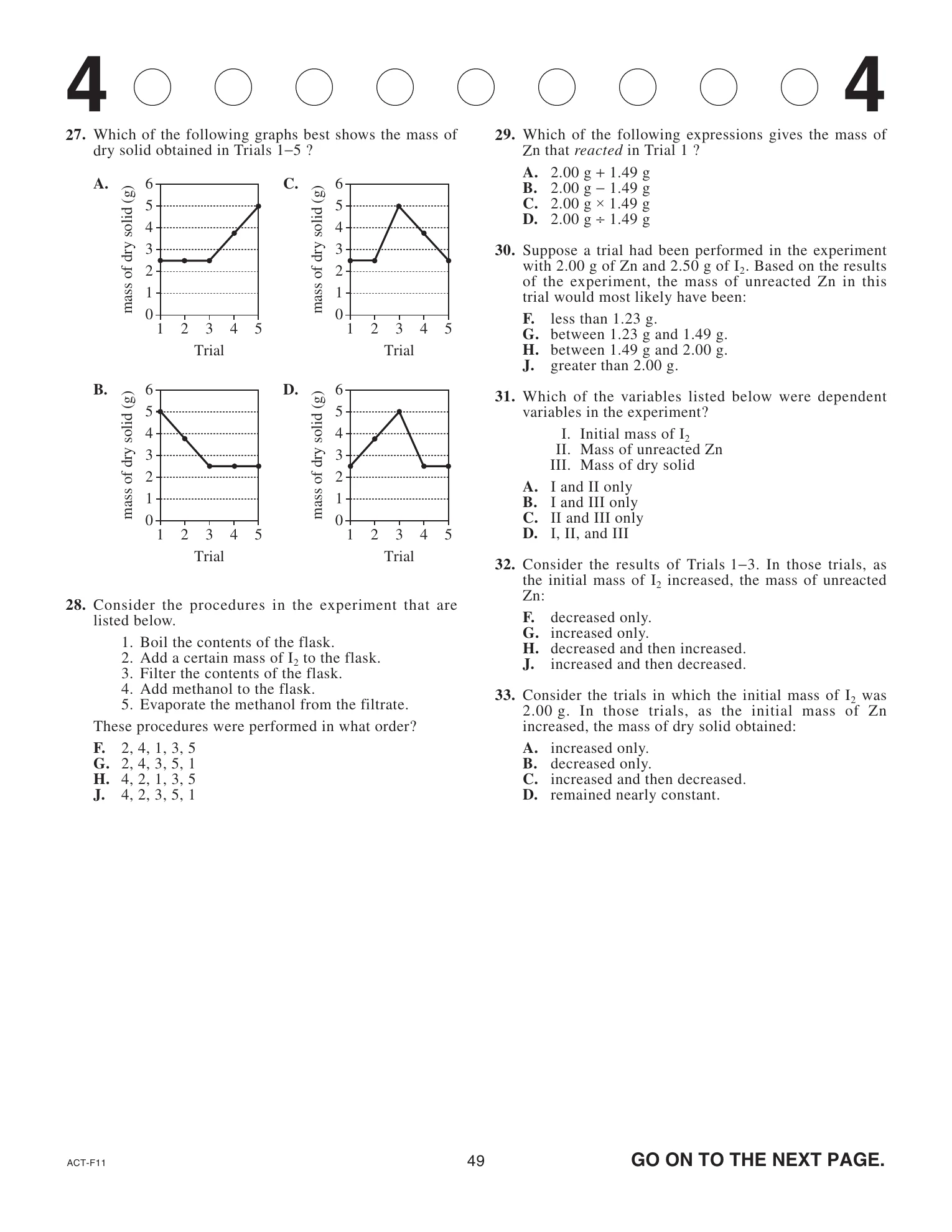
00 g. In those trials, as the initial mass of Zn increased, the mass of dry solid obtained: 6 5 4 3 2 1 0 mass of dry solid (g) Trial 1 2 3 4 5 6 5 4 3 2 1 0 mass of dry solid (g) Trial 1 2 3 4 5 6 5 4 3 2 1 0 mass of dry solid (g) Trial 1 2 3 4 5 6 5 4 3 2 1 0 mass of dry solid (g) Trial 1 2 3 4 5 49 GO ON TO THE NEXT PAGE. ACT-F11 4 4 50 GO ON TO THE NEXT PAGE. ACT-F11 4 4 Passage VI Three students were asked to estimate the Sun’s life span (the time that will have elapsed from the time the Sun began emitting energy until the time it exhausts its energy supply). The students were told that the Sun’s mass is about 1030 kg and that the Sun’s rate of energy emission is about 1034 joules per year (J/yr). Student 1 Energy is produced in the Sun by the combustion of molecular hydrogen gas (H2). In this chemical reaction, 2 molecules of H2 react with 1 molecule of oxygen gas (O2). For every 1 kg of H2 molecules consumed, about 108 J of energy is produced. Therefore, if the Sun was com- posed entirely of H2 at the start of its life span, then the Sun will have exhausted its fuel in approximately: 1030 kg H2 × × = 104 yr Thus, the Sun’s life span is 10 thousand years. Student 2 Energy is not produced in the Sun. The Sun formed when an interstellar cloud collapsed under the force of its own gravity. The collapse converted the cloud’s mechanical energy, E, into thermal energy (heat) that was stored in the forming solar core. The mechanical energy in the cloud is estimated to have been approximately 1041 this mechanical energy was converted to thermal energy as the Sun formed, then the Sun will have emitted all of it in approximately: 1041 J × = 107 yr Thus, the Sun’s life span is 10 million years. Student 3 Energy is produced in the Sun by the fusion of hydro- gen (H) nuclei. In this nuclear reaction, 4 H nuclei fuse together to form 1 helium (He) nucleus. For every 1 kg of H nuclei consumed, about 1015 J of energy is produced. However, only within the solar core (the innermost 10% of the Sun’s mass) are the temperature and pressure great enough for fusion to occur. Therefore, if the Sun was com- posed entirely of H at the start of its life span, then the Sun will have exhausted its fuel after approximately: 1029 kg H × × = 1010 yr Thus, the Sun’s life span is 10 billion years.