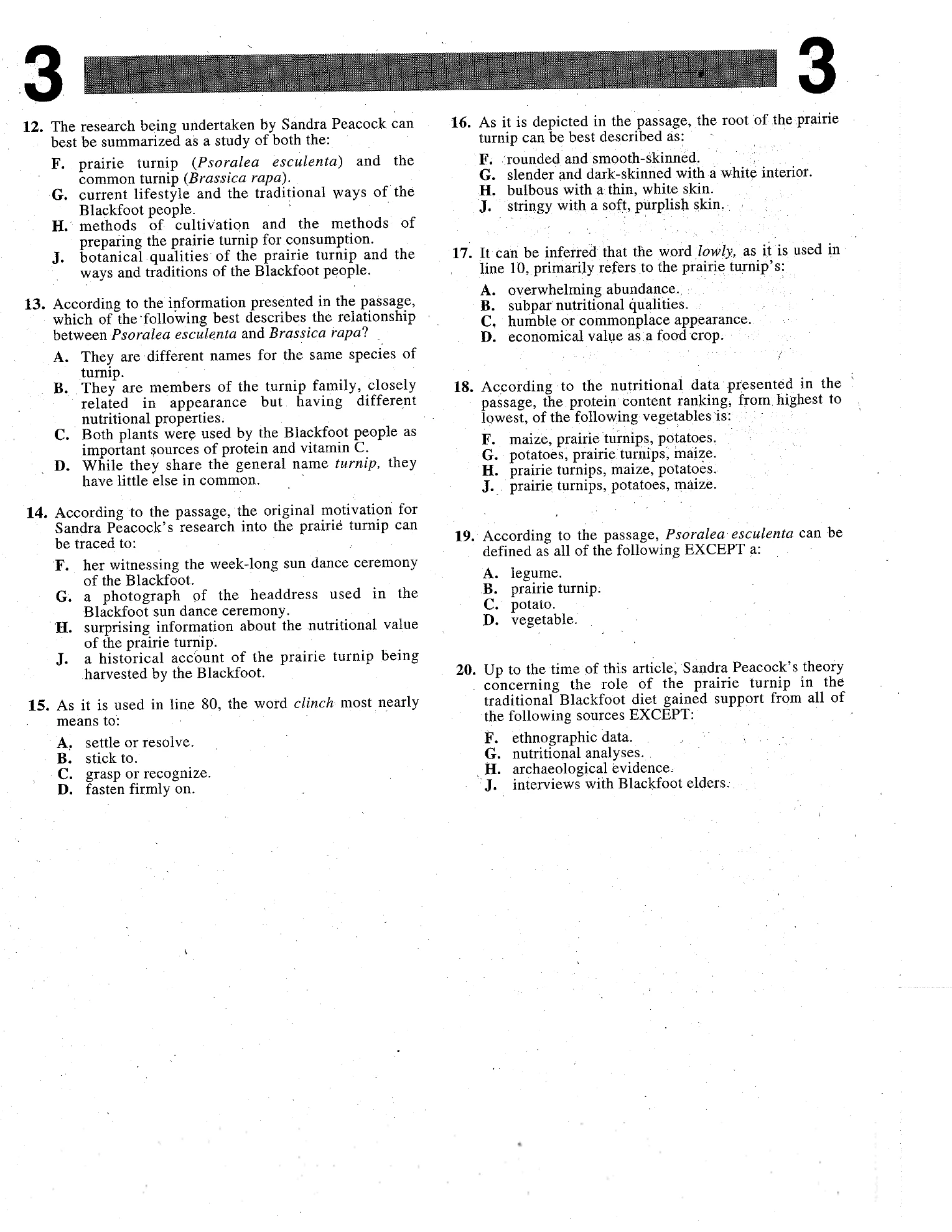
Up to the time of this article, Sandra Peacock's theory concerning the role of the prairie turnip in the traditional Blackfoot diet gained support from all of the following sources EXCEVf: ethnographic data. nutritional analyses. archaeological evidence. interviews with Blackfoot elders. settle or resolve. stick to. Passage 111 HUMANITIES: This passage is adapted from Alic8 Walker's autobiographical essay 'ln S8ar¢h of Our Mothers, Gardens" {@1974 by Alice Walker). How ilias the creativity of the Black woman kept alive, year after year and century after century, when for most of the years Black people have been in Ameiica, it was a punishable crime for a Black person 5 to read or write? And the freedom to paint. to sculpt, to expand the mind with action, did not exist. Consider, rf you can bear to imagine it, what might have been the result if singing, too, had been forbidden by law. Listen to the voices of Bessie Smith: Billie Holiday, Nina 10 Simone, Roberta Flack, and Aretha Franklin, among others, and imagine those voices muzzled for life. . In the late 1920's my mother ran away from home to marry my father. By the time she was twenty, she had two chil(Iren and was pregnant with a third. Five 15 children later, I was born. And this is how I came to know my mother.. she seemed a large, soft, lovkng-eyed woman who was rarely impatient in our home. Her quick, violent temper was on view only a few times a year, when she battled with the white landlord who had 20 the misfortune to suggest to her that her children did not need to go to school. and deep spiritual feeling. Below this quilt I saw a note that says It was made by "an anonymous Black woman 55 in Alabama a hundred years ago." If we could locate this "anonymous". Black woman from Alabama, she would turn out to be one of our grandmothers-an artist who left her mark in the only edium her position in society allowed her to use. And so it is, certainly, with my own mother. Unlike Ma Rainey's songs, which retained their cre- ator's name even while blastillg forth from Bessie Smith, s mouth, no song or poem will bear my mother's name...Yet so thany of the stOTies that I write, that we 65 all write, are my mother's stories. Qnly recently did I fully realize this." that, through years of listelling to my mother's stories of her life, I have absorbed not only the stories themselves, but something of the manner in which she spoke, something of the urgency that 70 involved the knowledge that her stori¢s-like her life- must be recorded. But the telling of these stories. which caine from tny mother's lips as naturally as breathing, was not the only way my mothet showed herself as'an artist. For 75 stOTies, too, were subject to being distracted, to dying without conclusion. Dinners must be started, and cotton ust be gathered before the big rains. The artist that was and is my mother showed itself to me only after many years. This is what I finally noticed. She planted ambitious gardens-and still does- with over fifty differFnt varieties of plants that bloom profusely from early March until late November. Before she left home for the fields, she watered her flowers, chopped up the grass, and laid out new beds. Whatever she planted grew as if by magic, and her fame as a grower of tlowers spread over three counties. Because of her creativity with her flowers, even my memories of poverty are seen through a screen of blooms. She made all the clothes we wore, even my brothers, overalls. She made all the towels and sheets we used. She spent the summers canning vegetables 25 and frnits. She spent the winter evenings making quilts enough to cover all our beds. 80 During the "working" day, she labored beside- not behind-my father in the fields. Her day began before sunup, and did not end until late at night. There 30 was never a moment for her to sit down, undisturbed, to unravel her own private thoughts. never a time free from interruption-by work or the noisy inquiries of her many children. And yet, it is to my Tnother-and all our mothers who were not farnous-that I went in 35 search of the secret of what has fed that mu7.zled and often mutilated. but vibrant, creative spirit that the Black woman has inherited, and that pops out in wild and unlikely places to this day. But when, you will ask, did my overworked 40 mother have time to know or care about feeding the creative spirit? 85