Questions 11-20 are based on the following
passage and supplementary material.
This passage is adapted from “How the Web Affects
Memory.” ©2011 by Harvard Magazine Inc.
Search engines have changed the way we use the
Internet, putting vast sources of information just a
few clicks away. But Harvard professor of psychology
Line Daniel Wegner’s recent research proves that
5 websites—and the Internet—are changing much
more than technology itself. They are changing the
way our memories function.
Wegner’s latest study, “Google Effects on
Memory: Cognitive Consequences of Having
10 Information at Our Fingertips,” shows that when
people have access to search engines, they remember
fewer facts and less information because they know
they can rely on “search” as a readily available
shortcut.
15 Wegner, the senior author of the study, believes
the new findings show that the Internet has become
part of a transactive memory source, a method by
which our brains compartmentalize information.
First hypothesized by Wegner in 1985, transactive
20 memory exists in many forms, as when a husband
relies on his wife to remember a relative’s birthday.
“[It is] this whole network of memory where you
don’t have to remember everything in the world
yourself,” he says. “You just have to remember who
25 knows it.” Now computers and technology as well
are becoming virtual extensions of our memory.
The idea validates habits already forming in our
daily lives. Cell phones have become the primary
location for phone numbers. GPS devices in cars
30 remove the need to memorize directions.
Wegner points out that we never have to stretch our
memories too far to remember the name of an
obscure movie actor or the capital of Kyrgyzstan—we
just type our questions into Google. “We become
35 part of the Internet in a way,” he says. “We become
part of the system and we end up trusting it.”
Working with researchers Betsy Sparrow of
Columbia University and Jenny Liu of the University
of Wisconsin–Madison, Wegner conducted four experiments to demonstrate the phenomenon, using
various forms of memory recall to test reliance on
computers. In the first experiment, participants
demonstrated that they were more likely to think of
computer terms like “Yahoo” or “Google” after being
45 asked a set of difficult trivia questions. In two other
experiments, participants were asked to type a
collection of readily memorable statements, such as
“An ostrich’s eye is bigger than its brain.” Half the
subjects were told that their work would be saved to a
50 computer; the other half were informed that the
statements would be erased. In subsequent memory
testing, participants who were told their work would
not be saved were best at recalling the statements. In
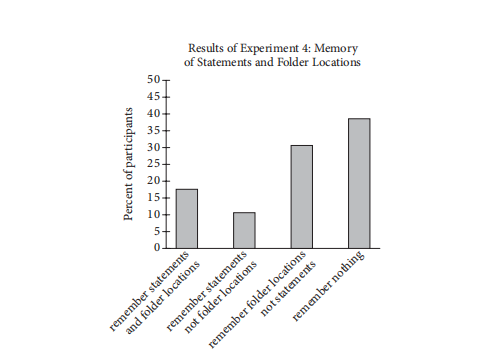
a fourth experiment, participants typed into a
55 computer statements they were told would be saved
in specific folders. Next, they were asked to recall the
statements. Finally, they were given cues to the
wording and asked to name the folders where the
statements were stored. The participants proved
60 better able to recall the folder locations than the
statements themselves.
Wegner concedes that questions remain about
whether dependence on computers will affect
memories negatively: “Nobody knows now what the
65 effects are of these tools on logical thinking.”
Students who have trouble remembering distinct
facts, for example, may struggle to employ those facts
in critical thinking. But he believes that the situation
overall is beneficial, likening dependence on
70 computers to dependence on a mechanical hand or
other prosthetic device.
And even though we may not be taxing our
memories to recall distinct facts, we are still using
them to consider where the facts are located and how
75 to access them. “We still have to remember things,”
Wegner explains. “We’re just remembering a
different range of things.” He believes his study will
lead to further research into understanding computer
dependence, and looks forward to tracing the extent
80 of human interdependence with the computer
world—pinpointing the “movable dividing line
between us and our computers in cyber networks.