Questions 12-22 are based on the following passage
and supplementary material.
Free Public Transportation
City planners, concerned about vehicle traffic
clogging their cities’ roadways, are trying to find ways to
get people out of their cars and onto buses and trains.
One radical proposal some planners have considered is to
make public transportation free to passengers. While
fare-free policies do increase (12) ridership, but they have
not been found to be an effective way to address traffic
problems. Moreover, these policies may result in serious
budget shortfalls.
Not surprisingly, (13) public transportation is used
by more people when people do not have to pay a fare.
According to a report by the Center for Urban
Transportation Research, public transit systems that
abolish fares typically see a short-term increase in
ridership of about 50 percent. However, this increase
does not necessarily correlate with a decrease in car
traffic. Evidence suggests that when buses and subways
are free, people often take bus and train trips they would
not have taken otherwise while still using their cars
nearly as much as they did before. In 2013 Tallinn,
Estonia, instituted fare-free rides for city residents
(becoming the largest city in the world to do so), but car
use in Tallinn has only slightly (14 )declined; as a 2014
study by the KTH Royal Institute of Technology in
Sweden found that car traffic in Tallinn was down less
than 3 percent since (15) it was enacted.
Instituting a fare-free system (16) can also have a
devastating effect on a city’s transportation budget. All
public transportation systems are subsidized by the
government to some extent, but large systems gain a
substantial portion of their operating revenue from fares.
Since systems that go fare-free see increases in ridership,
they often must operate more buses and trains and hire
more drivers and other personnel at the same time that
they are losing a key source of funding. Advocates of
fare-free policies claim that the costs of these policies are
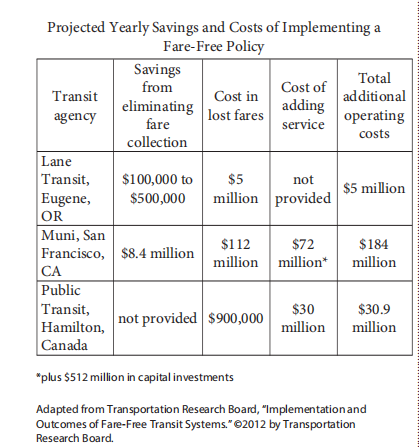
largely offset by various (17) savings, however, a recent
study comparing projected results of fare-free policies in
different cities found this outlook to be (18) way too
sunny. For example, in San Francisco, CA, fare-free
public transit was projected to save $8.4 million per year
in fare collection costs (19) but create a deficit of $72
million per year in lost fares, on top of capital
investments in new equipment and infrastructure.( 20)
Adapted from Transportation Research Board, “Implementation and
Outcomes of Fare-Free Transit Systems.” ©2012 by Transportation
Research Board.
This is not to say that fare-free public transportation
is always a bad idea. Some college towns and resort
communities embrace the model because buses can go
faster when drivers (21) would not have had to collect
fares. For large cities looking to reduce automobile traffic,
though, (22) research about Tallinn, Estonia, could be
instructive.
