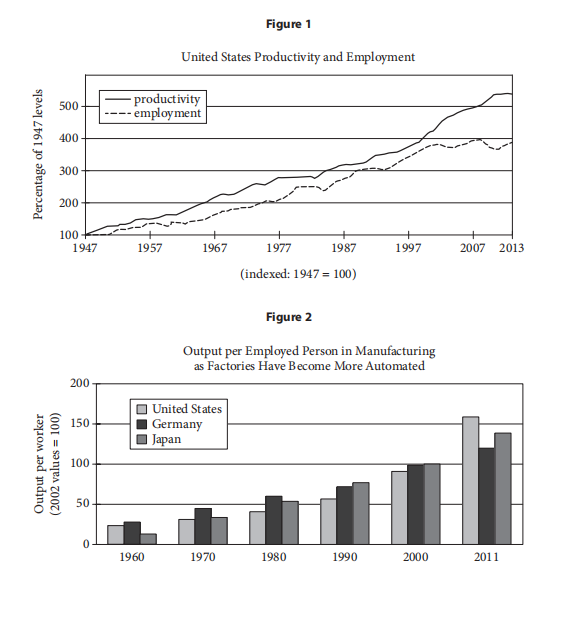
This passage is adapted from David Rotman, “HowTechnology Is Destroying Jobs.” ©2013 by MIT TechnologyReview.MIT business scholars Erik Brynjolfsson andAndrew McAfee have argued that impressiveadvances in computer technology—from improvedindustrial robotics to automated translationservices—are largely behind the sluggishemployment growth of the last 10 to 15 years. Evenmore ominous for workers, they foresee dismalprospects for many types of jobs as these powerfulnew technologies are increasingly adopted not onlyin manufacturing, clerical, and retail work but inprofessions such as law, financial services, education,and medicine.That robots, automation, and software can replacepeople might seem obvious to anyone who’s workedin automotive manufacturing or as a travel agent. ButBrynjolfsson and McAfee’s claim is more troublingand controversial. They believe that rapidtechnological change has been destroying jobs fasterthan it is creating them, contributing to thestagnation of median income and the growth ofinequality in the United States. And, they suspect,something similar is happening in othertechnologically advanced countries.As evidence, Brynjolfsson and McAfee point to achart that only an economist could love. Ineconomics, productivity—the amount of economicvalue created for a given unit of input, such as anhour of labor—is a crucial indicator of growth andwealth creation. It is a measure of progress. On thechart Brynjolfsson likes to show, separate linesrepresent productivity and total employment in theUnited States. For years after World War II, thetwo lines closely tracked each other, with increases injobs corresponding to increases in productivity. Thepattern is clear: as businesses generated more valuefrom their workers, the country as a whole becamericher, which fueled more economic activity andcreated even more jobs. Then, beginning in 2000, thelines diverge; productivity continues to rise robustly,but employment suddenly wilts. By 2011, asignificant gap appears between the two lines,showing economic growth with no parallel increasein job creation. Brynjolfsson and McAfee call it the“great decoupling.” And Brynjolfsson says he isconfident that technology is behind both the healthygrowth in productivity and the weak growth in jobs.It’s a startling assertion because it threatens thefaith that many economists place in technologicalprogress. Brynjolfsson and McAfee still believe thattechnology boosts productivity and makes societieswealthier, but they think that it can also have a darkside: technological progress is eliminating the needfor many types of jobs and leaving the typical workerworse off than before. Brynjolfsson can point to asecond chart indicating that median income is failingto rise even as the gross domestic product soars. “It’sthe great paradox of our era,” he says. “Productivityis at record levels, innovation has never been faster,and yet at the same time, we have a falling medianincome and we have fewer jobs. People are fallingbehind because technology is advancing so fast andour skills and organizations aren’t keeping up.”While technological changes can be painful forworkers whose skills no longer match the needs ofemployers, Lawrence Katz, a Harvard economist,says that no historical pattern shows these shiftsleading to a net decrease in jobs over an extendedperiod. Katz has done extensive research on howtechnological advances have affected jobs over thelast few centuries—describing, for example, howhighly skilled artisans in the mid-19th century weredisplaced by lower-skilled workers in factories.While it can take decades for workers to acquire theexpertise needed for new types of employment, hesays, “we never have run out of jobs. There is nolong-term trend of eliminating work for people. Overthe long term, employment rates are fairlystable. People have always been able to create newjobs. People come up with new things to do.”Still, Katz doesn’t dismiss the notion that there issomething different about today’s digitaltechnologies—something that could affect an evenbroader range of work. The question, he says, iswhether economic history will serve as a usefulguide. Will the job disruptions caused by technologybe temporary as the workforce adapts, or will we seea science-fiction scenario in which automatedprocesses and robots with superhuman skills takeover a broad swath of human tasks? Though Katzexpects the historical pattern to hold, it is “genuinelya question,” he says. “If technology disrupts enough,who knows what will happen?”