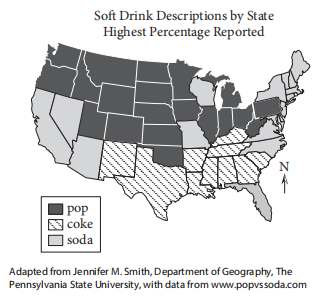
You Are Where You SayResearch on regional variations in English-languageuse has not only yielded answers to such (23) life-alteringquestions as how people in different parts of theUnited States refer to carbonated beverages (“soda”?“pop”? “coke”?) (24) it also illustrates how technology canchange the very nature of research. While traditional,human-intensive data collection (25 )has all butdisappeared in language studies, the explosion of socialmedia has opened new avenues for investigation.[1] Perhaps the epitome of traditional methodologyis the Dictionary of American Regional English,colloquially known as DARE. [2] Its fifth and finalalphabetical volume—ending with “zydeco”—released in2012, the dictionary represents decades of arduous work.[3] Over a six-year period from 1965 to 1970, universitygraduate students conducted interviews in more than athousand communities across the nation. [4] Their goalwas to determine what names people used for sucheveryday objects and concepts as a submarine sandwich(a “hero” in New York City but a “dagwood” in manyparts of Minnesota, Iowa, and Colorado) and a heavyrainstorm (variously a “gully washer,” “pour-down,” or“stump mover”). [5] The work that dictionary founderFrederic G. Cassidy had expected to be finished by 1976was not, in fact, completed in his lifetime. [6] The waitdid not dampen enthusiasm among (26 )scholars.Scholars consider the work a signal achievement inlinguistics.( 27)Not all research into regional English varieties(28 )requires such time, effort, and resources, however.Today’s researchers have found that the veritable army oftrained volunteers traveling the country conductingface-to-face interviews can sometimes be (29) replaced byanother army the vast array of individuals volunteeringdetails about their lives—and, inadvertently, theirlanguage—through social media. Brice Russ of Ohio StateUniversity, for example, has employed software to sortthrough postings on one social media (30) cite in searchof particular words and phrases of interest as well as thelocation from which users are posting. From these data,he was able, among other things, to confirm regionalvariations in people’s terms for soft drinks. As the mapshows, “soda” is commonly heard in the middle andwestern portions of the United States; “pop” is frequentlyused in many southern states; and “coke” is predominantin the northeastern and southwest regions but usedelsewhere as well. (31) As interesting as Russ’s findingsare, though, (32) they’re true value lies in their reminderthat the Internet is not merely a sophisticated tool forcollecting data but is also (33) itself a rich source of data.