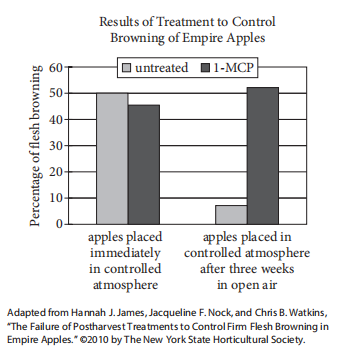
How Do You Like Those Apples?Marketed as SmartFresh, the chemical 1-MCP(1-methylcyclopropene) has been used by fruit growerssince 2002 in the United States and elsewhere to preservethe crispness and lengthen the storage life of apples andother fruit, which often must travel long distances beforebeing eaten by consumers. (23) 1-MCP lengthens storagelife by three to four times when applied to apples. Thisextended life allows producers to sell their apples in theoff-season, months after the apples have been harvested.And at a cost of about one cent per pound of apples,1-MCP is a highly cost-effective treatment. However,1-MCP is not a panacea for fruit producers or sellers:there are problems and limitations associated with its use.[1] 1-MCP works by limiting a fruit’s production ofethylene, (24) it is a chemical that causes fruit to ripen andeventually rot. [2] While 1-MCP keeps apples (25) tightand crisp for months, it also limits (26 )their scentproduction. [3] This may not be much of a problem withcertain kinds of apples that are not naturally veryfragrant, such as Granny Smith, but for apples that areprized for their fruity fragrance, such as McIntosh, thiscan be a problem with consumers, (27) that will rejectapples lacking the expected aroma. [4] But some fruits donot respond as well to 1-MCP as others (28) did, andsome even respond adversely. [5] Furthermore, somefruits, particularly those that naturally produce a large amount of ethylene, do not respond as well to 1-MCPtreatment. [6] Take Bartlett (29) pears, for instance, unlessthey are treated with exactly the right amount of 1-MCPat exactly the right time, they will remain hard and greenuntil they rot, and consumers who experience this will beunlikely to purchase them again. (30) Finally, researchers have found that 1-MCP actuallyincreases susceptibility to some pathologies in certainapple varieties. For example, Empire apples are prone to acondition that causes the flesh of the apple to turn brown.Traditionally, apple producers have dealt with thisproblem by leaving the apples in the open air for threeweeks before storing them in a controlled atmospherewith tightly regulated temperature, humidity, and carbondioxide levels. As the graph shows, the flesh of untreatedEmpire apples that are first stored in the open airundergoes (31) roughly five percent less browning thanthe flesh of untreated Empire apples that are immediatelyput into storage in a controlled environment. However,when Empire apples are treated with 1-MCP, (32) theirflesh turns brown when the apples are first stored in theopen air, though not under other conditions. Although researchers continue to search for the right combinationof factors that will keep fruits fresh and attractive, (33) the problem may be that consumers are overly concernedwith superficial qualities rather than the actual freshnessof the fruit.