Environmentalist Otters
It has long been known that the sea otters (23) living
along the West Coast of North America help keep kelp
forests in their habitat healthy and vital. They do this by
feeding on sea urchins and other herbivorous
invertebrates that graze voraciously on kelp. With sea
otters to keep the population of sea urchins in check, kelp
forests can flourish. In fact, (24) two years or less of sea
otters can completely eliminate sea urchins in a coastal
area (see chart).
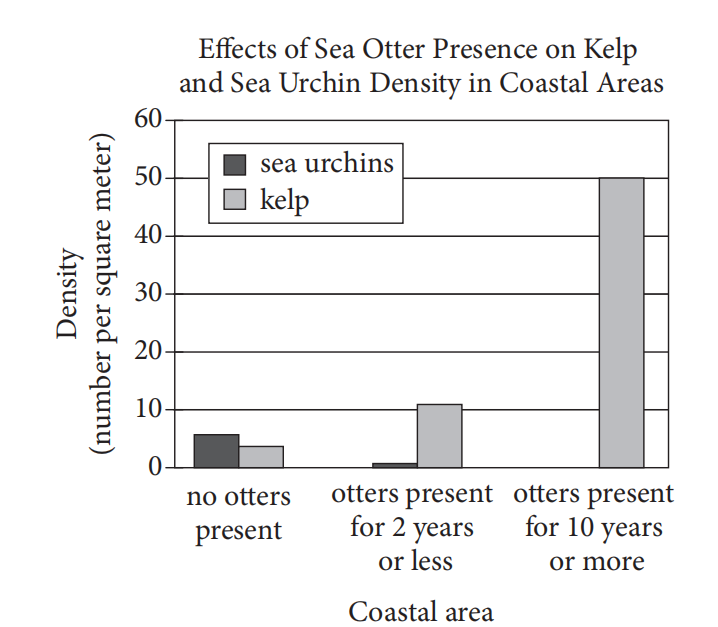
Without sea otters present, (25) nevertheless, kelp forests
run the danger of becoming barren stretches of coastal
wasteland known as urchin barrens [1] What was less well-known, until recently at least,
was how this relationship among sea otters, sea urchins,
and kelp forests might help fight global warming. [2] The
amount of carbon dioxide in the atmosphere has
increased 40 percent (26) . [3] A recent study by two
professors at the University of California, Santa Cruz,
Chris Wilmers and James Estes, (27) suggests, that kelp
forests protected by sea otters can absorb as much as
twelve times the amount of carbon dioxide from the
atmosphere as those where sea urchins are allowed to
(28) devour the kelp. [4] Like (29) their terrestrial plant
cousins, kelp removes carbon dioxide from the
atmosphere, turning it into sugar fuel through
photosynthesis, and releases oxygen back into the air.[5] Scientists knew this but did not recognize (30) how
large a role they played in helping kelp forests to
significantly decrease the amount of carbon dioxide in
the atmosphere. [6] Far from making no difference to the
ecosystem, the presence of otters was found to increase
the carbon storage of kelp forests by 4.4 to 8.7 megatons
annually, offsetting the amount of carbon dioxide
emitted by three million to six million passenger cars
each year. (31)
Wilmers and Estes caution, however, that( 32) having
more otters will not automatically solve the problem of
higher levels of carbon dioxide in the air. But they suggest
that the presence of otters provides a good model of how
carbon can be sequestered,( 33) or removed; from the
atmosphere through the management of animal
populations. If ecologists can better understand what
kinds of impacts animals might have on the environment,
Wilmers contends, “there might be opportunities for
win-win conservation scenarios, whereby animal species
are protected or enhanced, and carbon gets sequestered.”
