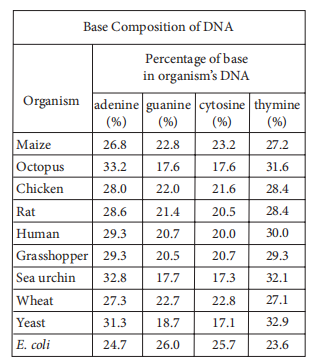
The chemical formula of deoxyribonucleic acid(DNA) is now well established. The molecule is avery long chain, the backbone of which consists of aLine regular alternation of sugar and phosphate groups.5 To each sugar is attached a nitrogenous base, whichcan be of four different types. Two of the possiblebases—adenine and guanine—are purines, and theother two—thymine and cytosine—are pyrimidines.So far as is known, the sequence of bases along the10 chain is irregular. The monomer unit, consisting ofphosphate, sugar and base, is known as a nucleotide.The first feature of our structure which is ofbiological interest is that it consists not of one chain,but of two. These two chains are both coiled around15 a common fiber axis. It has often been assumed thatsince there was only one chain in the chemicalformula there would only be one in the structuralunit. However, the density, taken with the X-rayevidence, suggests very strongly that there are two.20 The other biologically important feature is themanner in which the two chains are held together.This is done by hydrogen bonds between the bases.The bases are joined together in pairs,a single basefrom one chain being hydrogen-bonded to a single25 base from the other. The important point is that onlycertain pairs of bases will fit into the structure.One member of a pair must be a purine and the othera pyrimidine in order to bridge between the twochains. If apair consisted of two purines, for30 example,there would not be room for it.We believe that the bases will be present almostentirely in their most probable forms. If this is true,the conditions for forming hydrogen bonds are morerestrictive, and the only pairs of bases possible are:35 adenine with thymine, and guanine with cytosine.Adenine, for example, can occur on either chain; butwhen it does, its partner on the other chain mustalways be thymine.The phosphate-sugar backbone of our model is40 completely regular, but any sequence of the pairs ofbases can fit into the structure. It follows that in a long molecule many different permutations arepossible, and it therefore seems likely that the precise sequence of bases is the code which carries the45 genetical information. If the actual order of the bases on one of the pair of chains were given, one couldwrite down the exact order of the bases on the other one, because of the specific pairing. Thus one chain is, as it were, the complement of the other, and it is50 this feature which suggestshow the deoxyribonucleic acid molecule might duplicate itself.The table shows, for various organisms, the percentage ofeach of the four types of nitrogenous bases in that organism’s DNA