Dark SnowMost of Greenland’s interior is covered by a thicklayer of ice and compressed snow known as theGreenland Ice Sheet. The size of the ice sheet fluctuatesseasonally: in summer, average daily high temperaturesin Greenland can rise to slightly above 50 degreesFahrenheit, partially melting the ice; in the winter, thesheet thickens as additional snow falls, and average dailylow temperatures can drop(12)
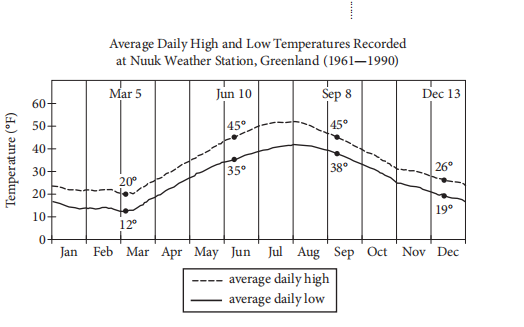
to as low as 20 degrees Typically, the ice sheet begins to show evidence ofthawing in late (13)summer. This follows several weeks ofhigher temperatures. (14)For example, in the summer of2012, virtually the entire Greenland Ice Sheet underwentthawing at or near its surface by mid-July, the earliestdate on record. Most scientists looking for the causes ofthe Great Melt of 2012 have focused exclusively on risingtemperatures. The summer of 2012 was the warmest in170 years, records show. But Jason(15) Box, an associateprofessor of geology at Ohio State believes that anotherfactor added to the early (16)thaw; the “dark snow”problem.According to Box, a leading Greenland expert,tundra fires in 2012 from as far away as North Americaproduced great amounts of soot, some( 17) of it driftedover Greenland in giant plumes of smoke and then(18) fell as particles onto the ice sheet. Scientists have longknown that soot particles facilitate melting by darkeningsnow and ice, limiting (19) it’s ability to reflect the Sun’srays. As Box explains, “Soot is an extremely powerfullight absorber. It settles over the ice and captures theSun’s heat.” The result is a self-reinforcing cycle. As theice melts, the land and water under the ice becomeexposed, and since land and water are darker than snow,the surface absorbs even more heat, which (20 )is relatedto the rising temperatures.[1] Box’s research is important because the fires of2012 may not be a one-time phenomenon. [2] Accordingto scientists, rising Arctic temperatures are makingnorthern latitudes greener and thus more fire prone.[3] The pattern Box observed in 2012 may repeat(21) itself again, with harmful effects on the Arcticecosystem. [4] Box is currently organizing an expeditionto gather this crucial information. [5] The next step forBox and his team is to travel to Greenland to performdirect sampling of the ice in order to determine just howmuch the soot is contributing to the melting of the icesheet. [6] Members of the public will be able to track histeam’s progress—and even help fund theexpedition—through a website Box has created. (22)
to as low as 20 degrees.
Which choice most accurately and effectively represents the information in the graph?
